Info
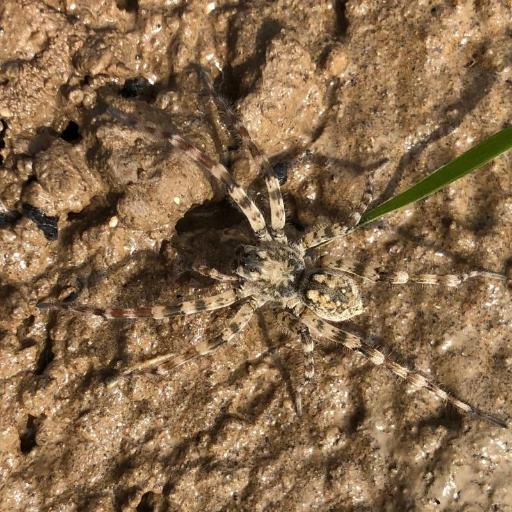
Known as the "Great Wolf Spider" or the "Ghost of the Riverbank," Arctosa cinerea is a master of disguise. This large, wandering spider is often found haunting the sandy shores of rivers and lakes across Europe and Northern Asia. Its common name comes from its incredible ability to vanish against a backdrop of pebbles and silt, appearing like a shifting shadow only when it moves.
🔍 How to Identify
- 🎨 Perfect Camouflage: Its body is covered in a mottled pattern of grey, brown, and black spots that mimic the exact texture of wet sand and river stones.
- 👀 Eight Piercing Eyes: Like all wolf spiders, it has two very large, forward-facing eyes that give it excellent night vision for hunting, with six smaller eyes arranged around them.
- 🦵 Robust Build: It is one of the largest wolf spiders in its range, featuring thick, hairy legs that allow it to sprint across unstable sand with surprising speed.
🌲 Habitat & Ecology
- 🏖️ The Shoreline Specialist: This spider is a habitat specialist, strictly living on undisturbed sandy or gravelly banks near water. It digs deep silk-lined burrows in the sand to stay cool and hidden during the day.
- 🏹 The Stealth Hunter: Unlike garden spiders, it doesn't spin webs to catch food. Instead, it acts as a nocturnal predator, stalking and pouncing on beetles, flies, and other small shoreline insects.
- 🌊 Water Resistance: It is remarkably adapted to life by the water; if the tide rises or a flood occurs, it can survive for extended periods trapped in air bubbles inside its burrow.
⚠️ Safety & Toxicity
- 🛡️ Non-Aggressive: While its large size can be intimidating, the Great Wolf Spider is incredibly shy and will almost always choose to run or hide rather than bite.
- 🐝 Mild Venom: Like almost all spiders, it possesses venom to submerge its prey. For humans, a bite is rare and generally no more painful than a mild bee sting, typically resulting in slight swelling or redness. It is not considered dangerous to pets or children.
✨ Fun Fact
The Arctosa cinerea is considered a "bio-indicator" species. Because it is so sensitive to water pollution and the artificial "channelization" of rivers, its presence is a sign of a very healthy, wild, and natural river ecosystem.
More Details








