Info
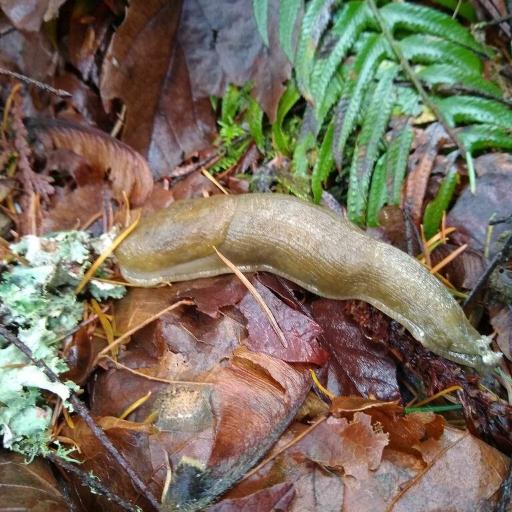
Often called the "Forest Banana," the Pacific Banana Slug is the slow-moving, vibrant giant of the Pacific Northwest floor. While it might look like a piece of overripe fruit dropped among the ferns, this mollusk is a vital "janitor" of the ecosystem, breaking down organic matter into rich soil. In local folklore and campus culture (notably UC Santa Cruz), it is celebrated as a gentle, quirky icon of the ancient redwoods.
🔍 How to Identify
- 🍌 Vibrant Color: Usually a bright "banana" yellow, but individuals can also be greenish-brown or even white.
- 🖤 Spotted Pattern: Many specimens feature large black blotches, making them look exactly like a ripening fruit.
- 🕳️ The Breathing Hole: Look for a distinct opening on the right side of its "shoulders" (the mantle); this is the pneumostome, used for breathing.
- 👀 Retractable Stalks: It has two pairs of tentacles—the top pair senses light and movement, while the bottom pair "smells" the trail ahead.
🌲 Habitat & Ecology
- 💧 Moisture Seekers: They thrive in temperate rainforests stretching from Alaska to California. You will find them under damp logs, among moss, or crossing trails after a heavy rain.
- 🍄 The Great Recycler: As detritivores, they eat fallen leaves, animal droppings, and especially mushrooms. By spreading spores and seeds through their waste, they help the forest regenerate.
- 🐌 Slime Engineering: Their mucus is a marvel of nature; it acts as both a lubricant for movement and an adhesive that allows them to crawl up vertical trees.
⚠️ Safety & Toxicity
- 🛡️ Non-Aggressive: Banana slugs are entirely harmless to humans. They do not bite, sting, or carry venom.
- 🧪 The "Numbing" Effect: Their slime contains an anesthetic. If a curious dog or predator tries to bite one, their mouth will go numb! While not poisonous, the slime is incredibly difficult to wash off skin or fur.
- 🧼 Hydration Warning: Never put salt on a slug. It causes rapid, painful dehydration. If you must move one, use a wet leaf to avoid stripping away its protective mucus.
✨ Fun Fact
The Pacific Banana Slug is the second-largest species of slug in the world, capable of growing up to 10 inches (25 cm) long. They can also move at a "blistering" top speed of about 6.5 inches per minute!
More Details








