Info
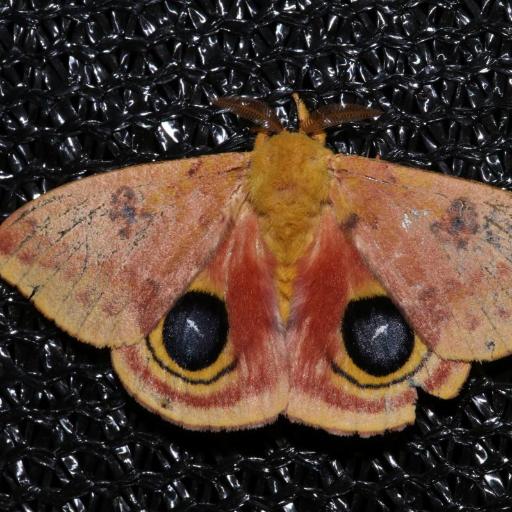
Meet the Io Moth, a master of deception and one of North America’s most striking nocturnal visitors. Named after Io, a priestess in Greek mythology, this moth hides a dramatic secret beneath its modest forewings. It is famous for its "eyespots," which it flashes to startle predators into thinking they’ve just stumbled upon the face of a much larger animal.
🔍 How to Identify
- 👁️ The False Eyes: The most iconic feature is the pair of large, peacock-like eyespots on the hindwings, colored in deep blue and black with a center white "pupil."
- 🦋 Color Differences: Males and females look quite different; males are a vibrant, sunny yellow, while females are typically larger with reddish-brown or purplish-gray forewings.
- 🐛 The "Stinger" Larva: The caterpillar is bright lime-green with a distinct red-and-white "racing stripe" along its side, covered in pom-pom-like clusters of branched spines.
🌲 Habitat & Ecology
- 🌳 A Wide Menu: The Io moth is a generalist. In your garden or local woods, you might find the caterpillars feeding on oak, willow, maple, hibiscus, or even clover.
- 🌙 Short-Lived Adults: Interestingly, the adult moths do not have functioning mouthparts. They never eat! They live for only about a week, using all their stored energy from their caterpillar days to find a mate and lay eggs.
⚠️ Safety & Toxicity
- 🚫 Stinging Caterpillar: While the adult moth is completely harmless and soft, the caterpillar is a "look but don't touch" insect.
- 🧪 Venomous Spines: The green spines are hollow and connected to poison glands. Touching them causes an immediate, painful "burning" sensation and a red, itchy rash. Keep curious children and pets away from the green, fuzzy caterpillars found on foliage.
✨ Fun Fact
When a bird approaches to eat the moth, the Io moth performs a "startle display." It quickly flips its front wings forward to reveal its giant hindwing "eyes." This split-second trick makes the bird think it has accidentally provoked an owl, giving the moth just enough time to fly away!
More Details








