Info
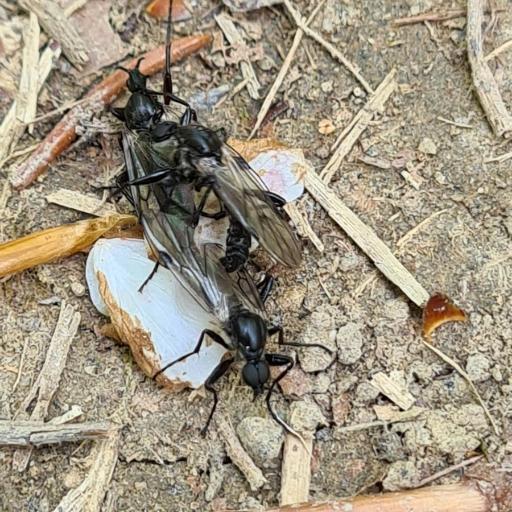
Meet the St. Mark’s Fly, a dark and fuzzy visitor that signals the true arrival of spring. Named because they traditionally emerge in massive numbers around St. Mark’s Day (April 25th), these flies are often seen drifting lazily through the air in large, clumsy swarms. While their heavy black bodies and dangling legs might look a bit intimidating, they are gentle giants of the fly world.
🔍 How to Identify
- 🪶 The "Hairy" Look: Their entire body is covered in short, dense black hairs, giving them a velvety, "tuxedo" appearance.
- 🦵 Dangling Legs: When in flight, they are easily recognized by their long back legs which hang down awkwardly, making them look like they are struggling to stay airborne.
- 👁️ Giant Eyes: Males have enormous, wrap-around eyes that meet in the middle and cover almost their entire head, while females have much smaller, widely spaced eyes.
- 🌑 Wing Spot: Their wings are mostly transparent or smoky-grey but feature a very distinctive dark mark (stigma) on the front edge.
🌲 Habitat & Ecology
- 🌱 The Gardener's Assistant: As larvae, they live underground and feed on decaying leaf litter and organic matter. This helps break down compost and recycle nutrients back into your soil.
- 🌸 Clumsy Pollinators: The adults feed on nectar and are surprisingly important pollinators for fruit trees, such as apples and pears, as well as many wildflowers.
- 🐦 Bird Buffet: Because they are slow, "drunken" flyers and emerge all at once, they provide a vital high-protein feast for birds feeding their spring chicks.
⚠️ Safety & Toxicity
- 🛡️ Completely Harmless: Despite their somewhat "spiky" look and dangling limbs, St. Mark's Flies do not sting, bite, or transmit any diseases to humans.
- 🐶 Safe for Pets: They are non-toxic to dogs and cats. While a curious pet might try to eat one, these flies offer no defense other than being a bit crunchy.
✨ Fun Fact
The males are famous for their "yo-yo" flight pattern. They hover in the air, bobbing up and down in large groups to catch the attention of females. Because they are such poor flyers, a sudden gust of wind often blows the entire swarm into the faces of unsuspecting hikers!
More Details