Info
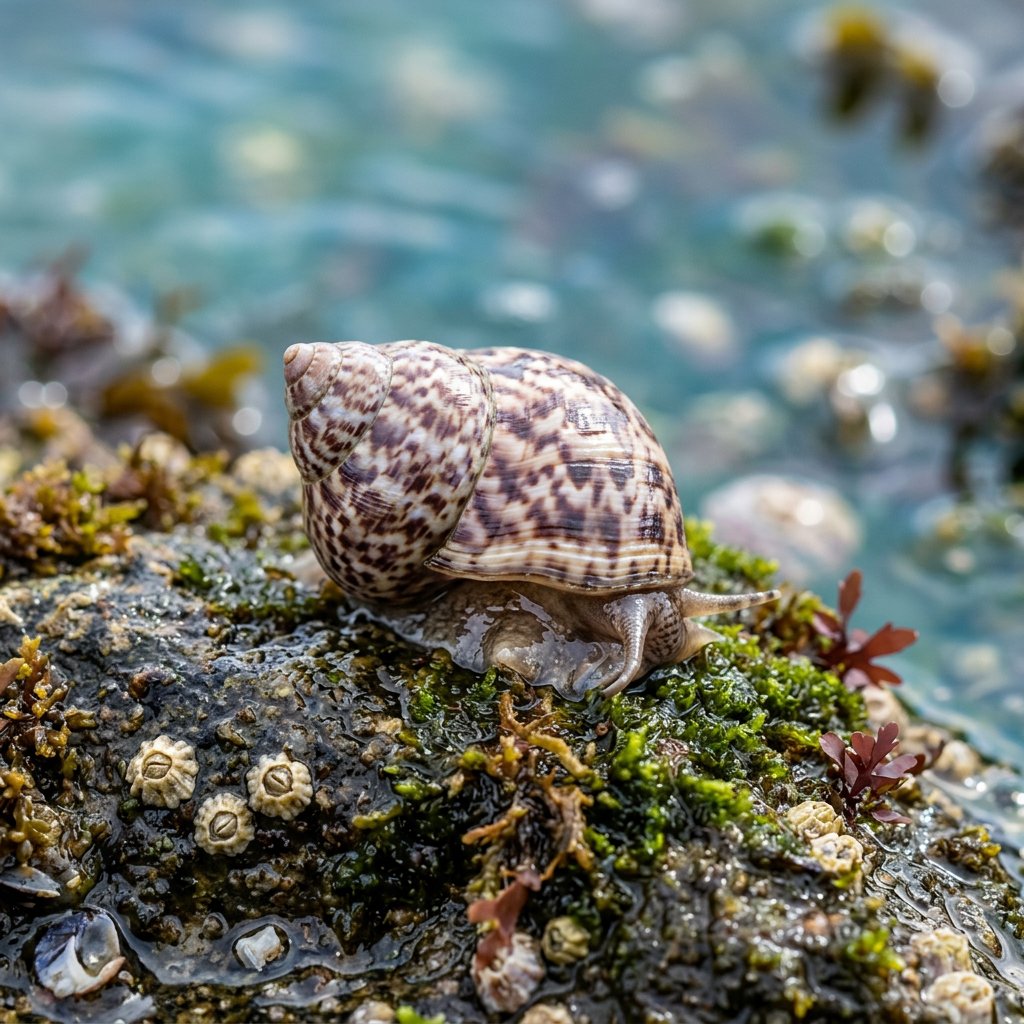
Often called the European Painted Top Snail, this marine gem is one of the most beautiful creatures found along European coastlines. Although it is a seafaring mollusk and not an insect, its striking colors and intricate patterns often lead people to mistake it for a decorative garden ornament. It looks more like a hand-painted piece of jewelry than a common sea snail.
🔍 How to Identify
- 🐚 Perfect Cone: The shell is a distinct, sharp-pointed triangle or "top" shape with straight, flat sides that form a near-perfect geometric cone.
- 🎨 Painted Patterns: The base color is usually a pinkish-mauve or yellowish-cream, decorated with bold, slanted streaks or spots of reddish-brown.
- ✨ Pearly Interior: The inside of the shell is lined with a stunning, iridescent mother-of-pearl (nacre) that shimmers when caught in the light.
🌊 Habitat & Ecology
- 🪨 Rocky Shoreline: These snails are masters of the intertidal zone, clinging to rocks and boulders from the low-tide mark down to depths of over 300 meters.
- 🍽️ The "Sea Fur" Diet: Unlike many of its cousins that scrape algae from rocks, the Painted Top Snail is a specialized feeder that often grazes on tiny colonial animals called hydroids, which look like fuzzy plants growing on underwater surfaces.
- 🧬 Clever Movement: They are surprisingly mobile for snails, using a strong muscular "foot" to navigate the treacherous currents of the Atlantic and Mediterranean coasts.
⚠️ Safety & Toxicity
- 🟢 Harmless Traveler: This species is entirely non-toxic and lacks any stingers or venomous capabilities.
- 🐚 Fragile Beauty: While safe for humans, the snail is very delicate. If you find a live one in a tide pool, it is best to observe without touching, as their shell edges can be brittle and their internal membranes are sensitive to skin oils.
✨ Fun Fact
The species name zizyphinum comes from "Ziziphus," the genus of the jujube fruit tree. Early naturalists thought the shape and reddish-brown patterns of the snail’s shell bore a striking resemblance to the small, colorful jujube fruit!
More Details








