Info
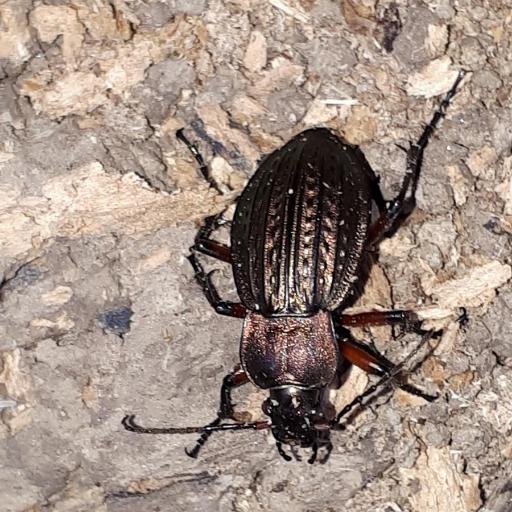
Known as the "Cancellate Ground Beetle," this iridescent predator is one of the most hardworking "tiny bodyguards" a gardener could ask for. Its name comes from the lattice-like (cancellate) pattern on its wing cases, making it look as though it is wearing a finely etched suit of bronze armor. While its speed might startle you, it is a fierce ally in the natural struggle against garden pests.
🔍 How to Identify
- 🪲 The Armor: The wing covers (elytra) are typically a coppery, bronze, or dull green metallic color, featuring prominent longitudinal ridges.
- 🧬 Lattice Pattern: Between the main ridges, you will notice rows of small pits or "chain-like" interruptions, which give the insect its "cancellatus" name.
- 🦵 Antennal Accent: A key identification feature is the first segment of the antennae, which is often a distinct reddish-orange color, contrasting with the darker segments and legs.
🌲 Habitat & Ecology
- 🐌 The Slug Hunter: These beetles are voracious carnivores. They use their powerful mandibles to hunt down slugs, snails, and earthworms, making them a natural alternative to chemical pesticides in your vegetable patch.
- 🌑 Night Patrol: While they are sometimes active on overcast days, they are primarily nocturnal "ground-runners." They do not fly because their wing cases are fused together, so they rely on their long, powerful legs to navigate forests, fields, and gardens.
⚠️ Safety & Toxicity
- 🛡️ Harmless Ally: The Cancellate Ground Beetle is non-toxic and lacks a stinger. It poses no threat to humans, pets, or property.
- 🤏 Defense Mechanisms: If handled roughly, it may deliver a tiny, harmless "pinch" with its mandibles or release a pungent-smelling secretion to discourage predators. It is best to observe these beetles from a distance or gently move them with a leaf.
✨ Fun Fact
Because they cannot fly, Carabus cancellatus populations are often used by scientists as "bioindicators" to measure the health and connectivity of a landscape; if the beetles are present, it means the local ecosystem is stable enough to support their long-term ground travel!
More Details








