Info
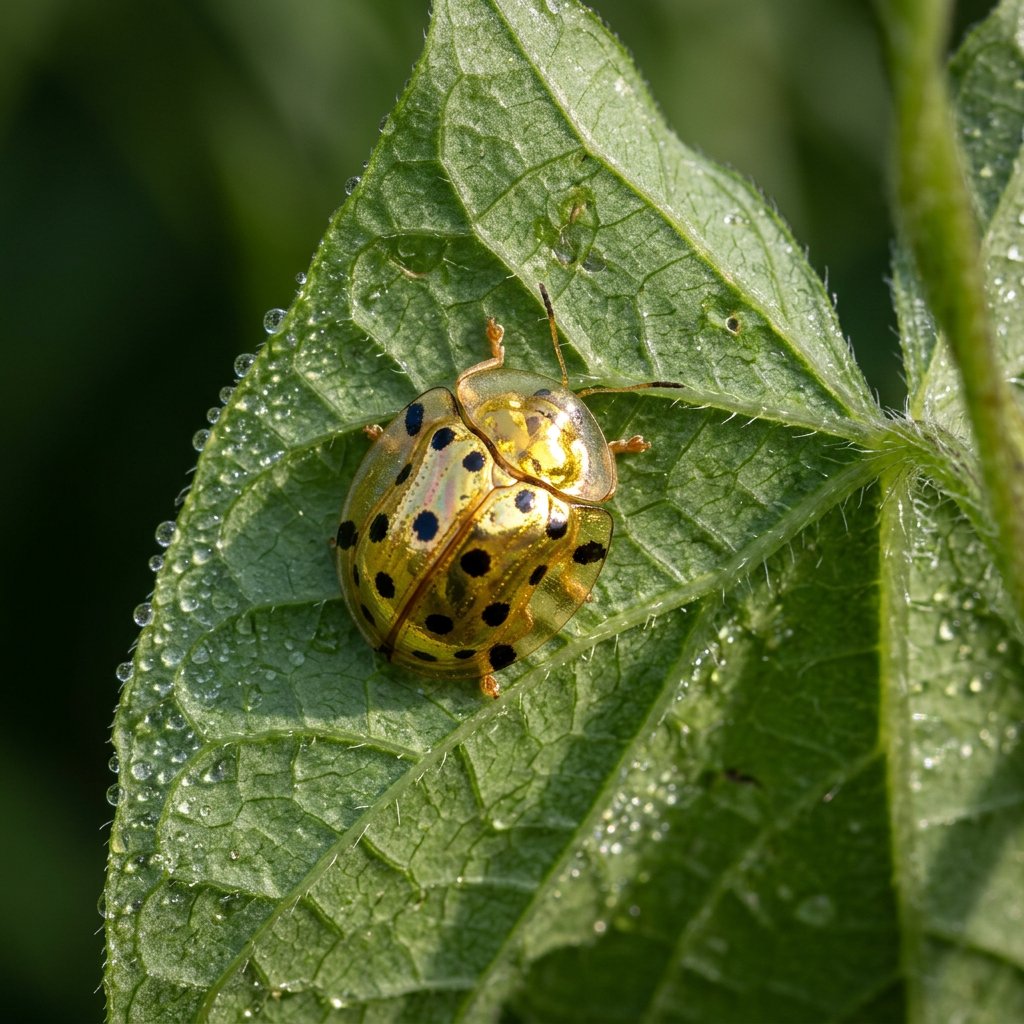
Meet the "living jewel" of the garden! Known most commonly as the Golden Tortoise Beetle, this tiny insect looks more like a piece of lost pirate treasure than a common bug. Often found clinging to the undersides of leaves, it is famous for its incredible ability to shift its color from a brilliant 24-karat metallic gold to a dull, spotted reddish-brown in an instant.
🔍 How to Identify
- 🐞 Transparent Margin: The outer edges of its wing covers (elytra) are completely clear and see-through, creating a "turtle shell" canopy that extends beyond its body.
- ✨ Metallic Sheen: In its relaxed state, it displays a mirror-like golden finish that reflects light like a polished coin.
- ⚫ The Six Spots: As the scientific name sexpunctata suggests, when the beetle loses its gold luster, six small black dots become visible on its back against a reddish background.
🌲 Habitat & Ecology
- 🍃 Morning Glory Specialist: You will almost exclusively find these beetles on plants in the Convolvulaceae family. If you have Morning Glories or Sweet Potato vines in your garden, keep a close eye on the foliage.
- 😋 Leaf Muncher: Both the larvae and adults feed on leaf tissue. While they do create small, "shot-hole" patterns in leaves, they are usually considered a minor garden curiosity rather than a destructive pest.
- 🛡️ The Fecal Shield: The larvae have a bizarre defense mechanism; they construct a "shield" out of their own shed skin and waste to deter predators like ants and birds.
⚠️ Safety & Toxicity
- ✅ Harmless Friend: These beetles are completely safe for humans. They do not bite, sting, or carry any venom.
- 🐾 Non-Toxic: They pose no threat to curious cats or dogs. They rely on camouflage and their "turtle" shape for protection rather than chemical defenses.
- 🌾 Garden Health: They are generally neutral. Unless you are growing sweet potatoes commercially, there is rarely a need to remove them; they are a sign of a biodiverse garden.
✨ Fun Fact
The Golden Tortoise Beetle is the "mood ring" of the insect world! Its color change isn't caused by pigments, but by microscopic layers of fluid under its shell. When the beetle is stressed, mating, or even just thirsty, it moves this fluid away, causing the golden reflection to "evaporate" and reveal the duller colors beneath.
More Details








