Info
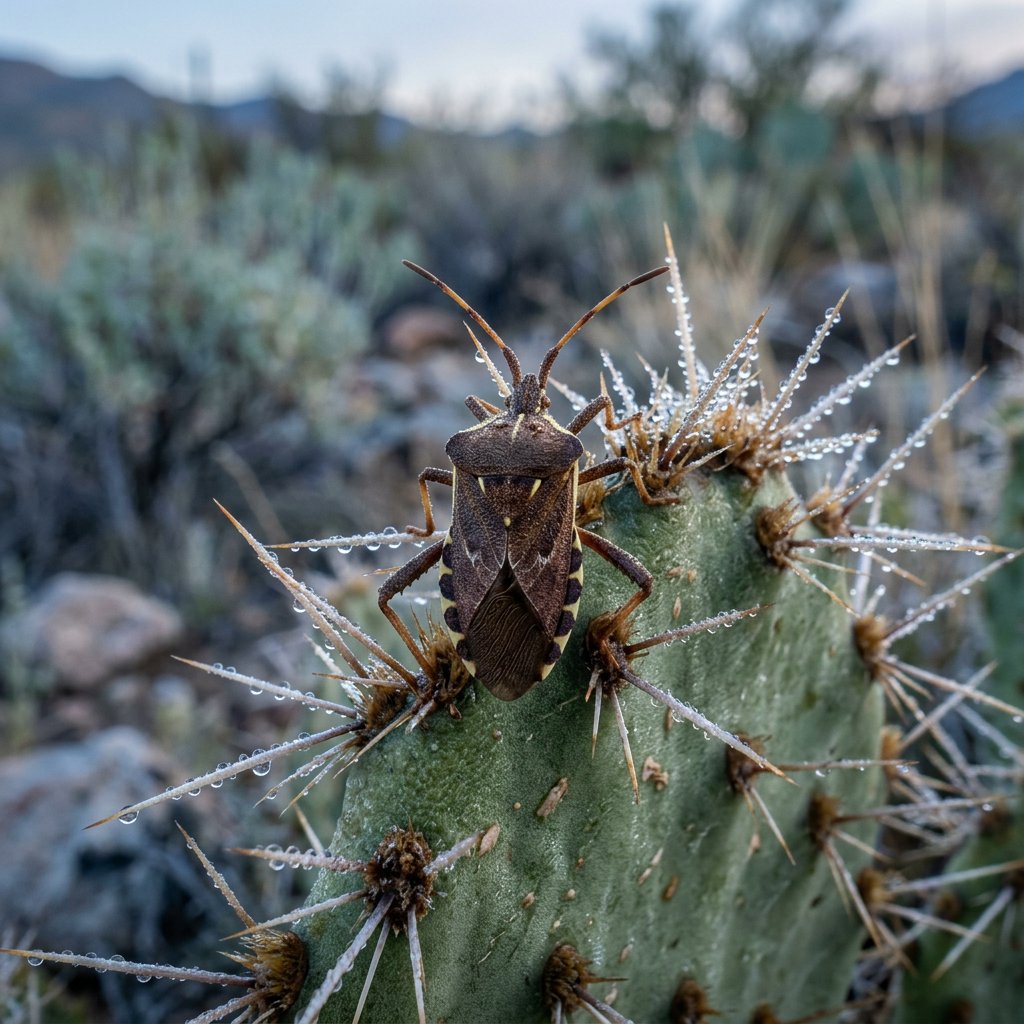
Often found clinging to the spines of prickly pear cacti, the Cactus Coreid is a specialized feeder that looks like a miniature, armored tank. While its sharp-angled shoulders and long, probing beak might look intimidating, this insect is a slow-moving sap-sucker that spends its entire life cycle dedicated to a single plant family. In the garden, they are generally considered "foes" to succulent lovers, but they are a fascinating example of evolutionary specialization.
🔍 How to Identify
- 🌵 The Profile: A sturdy, oval-shaped body, typically dull grayish-brown or tan, which helps it blend in perfectly with dried cactus pads.
- 🎨 Head Markings: Look for distinct yellow or orange longitudinal stripes on the head and the "shoulders" (pronotum), which act as a signature for this species.
- 🦵 Leg Texture: Unlike their "leaf-footed" cousins, these bugs have relatively simple, thick hind legs without the wide, leaf-like expansions.
- 🪽 Ventral View: If you flip one over (carefully!), you will see a long, straw-like rostrum (beak) tucked between its legs, used for piercing thick cactus skin.
🌲 Habitat & Ecology
- 🍽️ Dietary Specialist: These insects are "monophagous," meaning they feed almost exclusively on Opuntia (Prickly Pear) and occasionally Cylindropuntia (Cholla). They use their mouthparts to suck out the nutrient-rich juices of the cactus.
- 📍 The "Calling Card": You can tell they’ve been around by the circular, yellowish-white scars they leave on cactus pads. In large numbers, they can cause the pads to wilt or drop.
- 🐣 Family Life: They often congregate in small groups. The nymphs (juveniles) are much brighter than the adults, often appearing strikingly orange or reddish before they mature into their camouflaged adult tones.
⚠️ Safety & Toxicity
- 🛡️ Status: Completely harmless to humans and pets. They do not bite, sting, or carry diseases.
- 👃 Chemical Defense: Like many members of the "True Bug" order, they possess scent glands. If handled roughly, they may release a pungent, foul-smelling liquid to discourage predators (and curious gardeners).
- 🧤 Handling: If you need to move them, use a soft brush or wear gloves, primarily to avoid the cactus spines they live among rather than the bug itself!
✨ Fun Fact
Because of their absolute devotion to eating prickly pears, Chelinidea vittiger was once exported from the United States to Australia to help control invasive cactus populations that were taking over the outback!
More Details








