Info
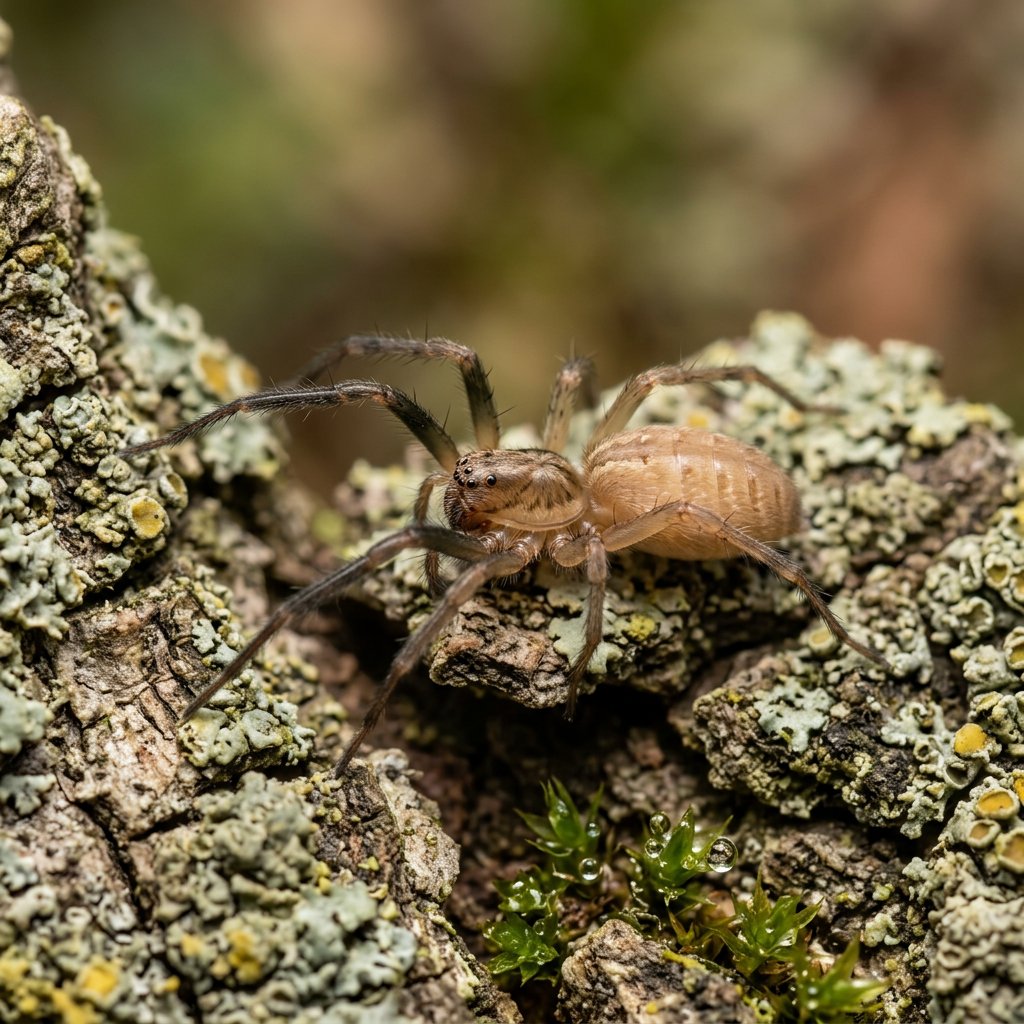
Known as the Bark Sac Spider, this sleek arachnid is a master of camouflage and structural engineering. It belongs to a group of spiders that don't spin traditional circular webs to catch food; instead, they build silken "sleeping bags" or retreats. While their large mouthparts might look intimidating, they are actually shy, nocturnal neighbors that play a vital role in keeping your garden’s pest population under control.
🔍 How to Identify
- 🕷️ The Pattern: Look for a distinct, dark "leaf-like" or heart-shaped mark (called a folium) running down the center of its greyish-brown abdomen.
- 🧶 Silken Retreats: You can often find them by looking for flat, tubular sacs made of dense white silk tucked into crevices or under loose tree bark.
- 🦷 Prominent Chelicerae: They possess relatively large, dark mouthparts (fangs) compared to their body size, which they use to grasp prey while hunting on foot.
🌲 Habitat & Ecology
- 🪵 Bark Dweller: As the name corticalis suggests, these spiders are specialists of the tree trunk. They are most commonly found on pines, oaks, and fruit trees, hiding in the deep furrows of the bark during the day.
- 🌙 Active Prowler: Instead of waiting for food to fly into a web, they emerge at night to hunt. They are fast runners and rely on their speed and vibration sensitivity to track down flies, moths, and small beetles.
⚠️ Safety & Toxicity
- 🩹 Status: Generally harmless to humans and non-aggressive.
- 🐕 Details: While Clubiona corticalis is capable of biting if squeezed or trapped against the skin, their venom is not medically significant. A bite may cause minor localized redness or a stinging sensation similar to a small ant bite. They pose no serious threat to curious cats or dogs.
✨ Fun Fact
These spiders are known for their "maternal devotion." After laying her eggs inside a thick silken sac, the female will often stay and guard the retreat until the spiderlings hatch, sometimes even sacrificing her own body to provide a first meal for her young (a behavior known as matriphagy).
More Details








