Info
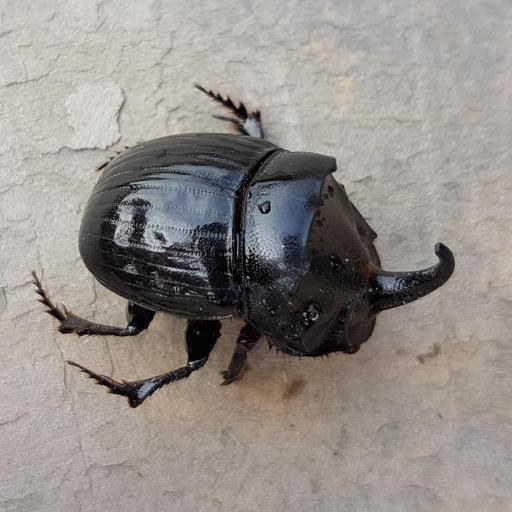
Known as the Spanish Dung Beetle, Copris hispanus is a heavy-duty recycler often compared to a miniature rhinoceros. This robust beetle is a legendary figure in Mediterranean pastures, where it has spent millennia as "nature’s janitor." Though its lifestyle might seem unglamorous, it plays a vital role in keeping ecosystems clean and fertile.
🔍 How to Identify
- 🦏 The Great Horn: Males possess a magnificent, curved horn on the head that leans backward toward a specialized "shelf" on the thorax. Females have a much smaller, subtle tubercle.
- 🖤 Midnight Armor: Their body is a deep, glossy jet-black, featuring wing covers (elytra) with distinct, deeply etched longitudinal grooves.
- 🧱 Built for Power: They have a wide, shovel-like head and thick, serrated front legs designed specifically for heavy excavation and tunneling.
🌲 Habitat & Ecology
- 💩 Sanitation Expert: These beetles are "tunnelers." Unlike the famous rollers, Copris hispanus digs deep shafts directly beneath or next to dung piles to transport food underground.
- 🌱 Soil Engineer: By burying organic matter, they aerate the soil, reduce fly populations, and recycle nutrients directly into the earth, making them a massive asset to farmers and gardeners.
- 🛡️ Subterranean Life: They prefer warm, Mediterranean climates and are most active in open grasslands, pastures, and scrublands where livestock or wild herbivores graze.
⚠️ Safety & Toxicity
- ✅ Harmless Helper: The Spanish Dung Beetle is completely harmless to humans. They do not sting, and their mouthparts are designed for soft matter, not biting.
- 🐾 Pet Friendly: They are non-toxic to dogs or cats. If a pet accidentally finds one, the beetle's primary defense is simply to pull its legs in and "play dead" until the threat passes.
✨ Fun Fact
Copris hispanus exhibits rare parental devotion! Unlike many insects that lay eggs and vanish, the mother beetle often stays in the underground chamber to "groom" the dung balls, preventing lethal mold from growing on them until the larvae are ready to emerge.
More Details








