Info
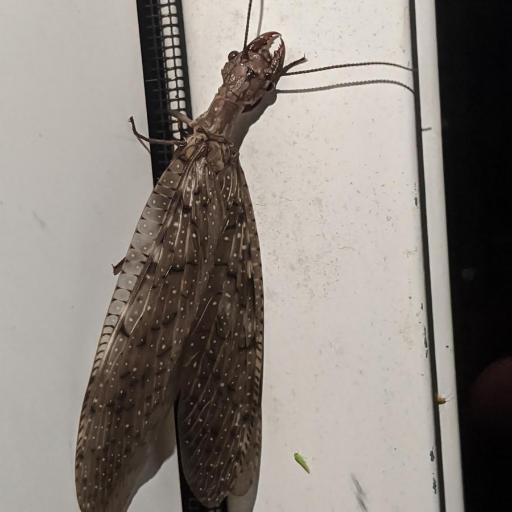
Often called the "King of the River," the Eastern Dobsonfly looks like a creature straight out of a prehistoric nightmare. With a massive wingspan and intimidating pincers, these insects are frequent nocturnal visitors to porch lights near freshwater sources. Despite their fierce "monster" appearance, they are actually vital indicators of a healthy, unpolluted environment.
🔍 How to Identify
- ⚔️ The Mandibles: Males possess long, sickle-shaped "tusks" that can be half the length of their body, while females have much shorter, stout pincers.
- 🕸️ Lacy Wings: They have four large, smoky-translucent wings with a complex network of dark veins, often spanning up to 5 inches.
- 🎨 Color & Form: Their bodies are typically a dull brownish-gray or tan, designed to blend into tree bark and river stones during the day.
🌲 Habitat & Ecology
- 💧 Clean Water Lovers: You will almost always find them near fast-flowing streams or rivers. Their presence is a "green flag" for water quality, as they cannot survive in polluted or low-oxygen environments.
- 🌑 Night Owls: Adults are nocturnal and are highly attracted to bright lights. During the day, they hide under leaves or bridge abutments near the water's edge.
- 🎣 The Hellgrammite Phase: Before they grow wings, they spend 2–3 years underwater as "hellgrammites"—fearsome aquatic predators that are highly prized by fishermen as bait.
⚠️ Safety & Toxicity
- 🤏 The "Bluff" Pincers: While the male’s giant tusks look terrifying, they are too long and clumsy to cause any harm; they are used only to hold females during mating.
- 💥 Female Bite: Exercise caution with the females. Their shorter, powerful mandibles are designed for defense and can deliver a sharp, painful nip if they feel threatened.
- 🚫 Non-Venomous: They do not possess venom or stingers. Any "bite" is purely mechanical and, while startling, is not dangerous to humans or pets.
✨ Fun Fact
Adult Dobsonflies are the ultimate "starving artists"—they rarely eat during their short adult life. After spending years as larvae, the winged adults live for only a few days, dedicating all their energy to finding a mate before they perish.
More Details








