Info
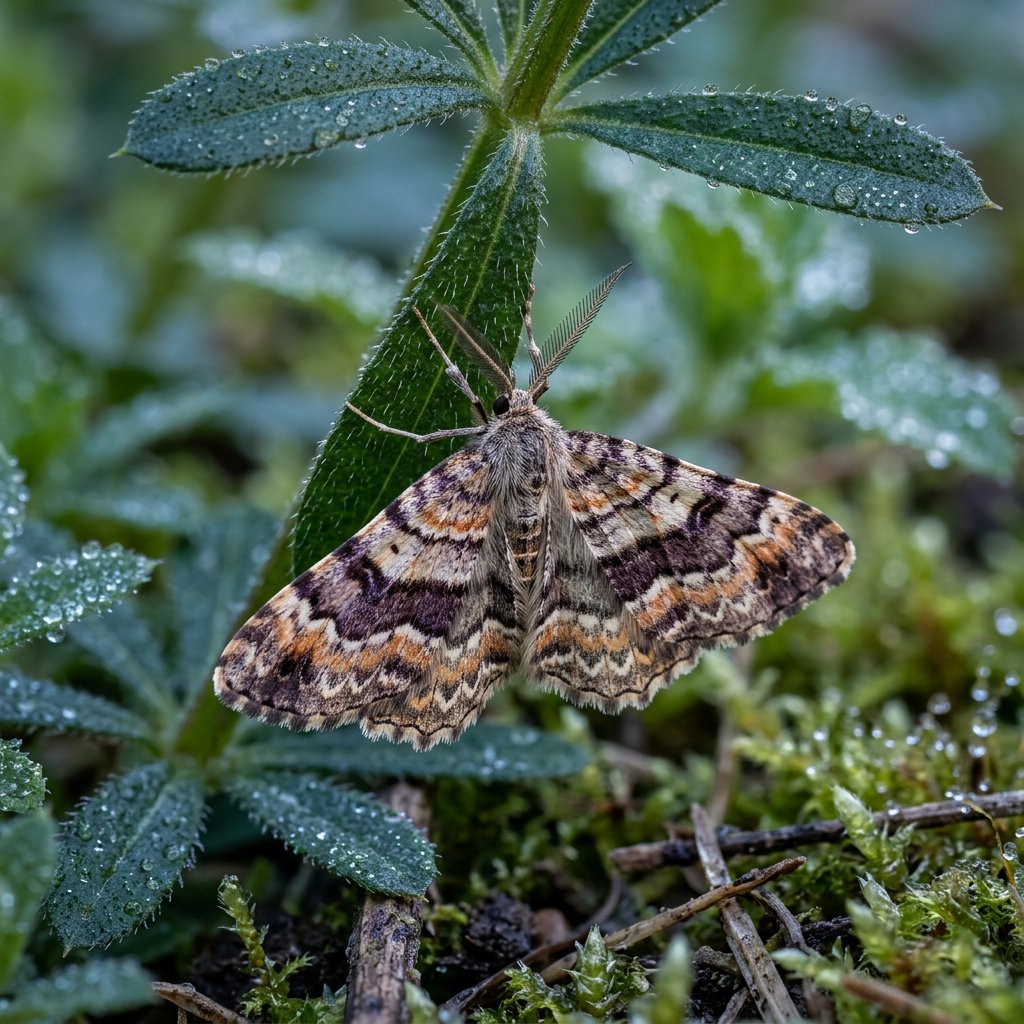
Known as the Purple Bar Carpet, this elegant moth is a striking example of nature’s geometric art. Despite its name, it doesn't live in your floorboards—the "carpet" designation refers to its intricate, rug-like wing patterns. It is a gentle, harmless "friend" of the garden that looks like a tiny piece of Victorian lace resting against a leaf.
🔍 How to Identify
- 🦋 The "Purple Bar": The most distinct feature is a broad, dark brown or purplish-black band that runs across the center of its creamy-white forewings.
- 📐 Triangular Silhouette: When at rest, it holds its wings flat and slightly angled, creating a clean, triangular shape typical of the Geometer moth family.
- 🖋️ Dark Basal Patch: Look for a small, dark triangular patch at the very base of the wing (where it meets the body), which mirrors the color of the central band.
🌲 Habitat & Ecology
- 🥗 Bedstraw Specialist: The larvae are very particular eaters, feeding primarily on Bedstraw (Galium) species. If you have these wildflowers in your garden or nearby meadows, you are likely to see this moth.
- 🌓 Easily Disturbed: While they are technically nocturnal and fly after dark, they are "light sleepers." You’ll often see them flutter out of hedges or tall grass if you walk past them during the day.
- 🏡 Garden Visitor: They are common in gardens, hedgerows, and woodland clearings across Europe and parts of Asia, appearing in two waves—one in late spring and another in late summer.
⚠️ Safety & Toxicity
- ✅ Completely Harmless: The Purple Bar Carpet has no stinger, does not bite, and does not produce any known toxins.
- 👐 Gentle Handling: Like all moths, their wings are covered in microscopic scales. If you must move one, let it crawl onto a piece of paper rather than touching its wings, which can damage its ability to fly.
✨ Fun Fact
- 🎭 Latin Logic: Its scientific name ocellata comes from the Latin word for "little eye," referring to the small, faint eye-like spots near the wing tips that help distract birds and other predators from its vulnerable body.
More Details








