Info
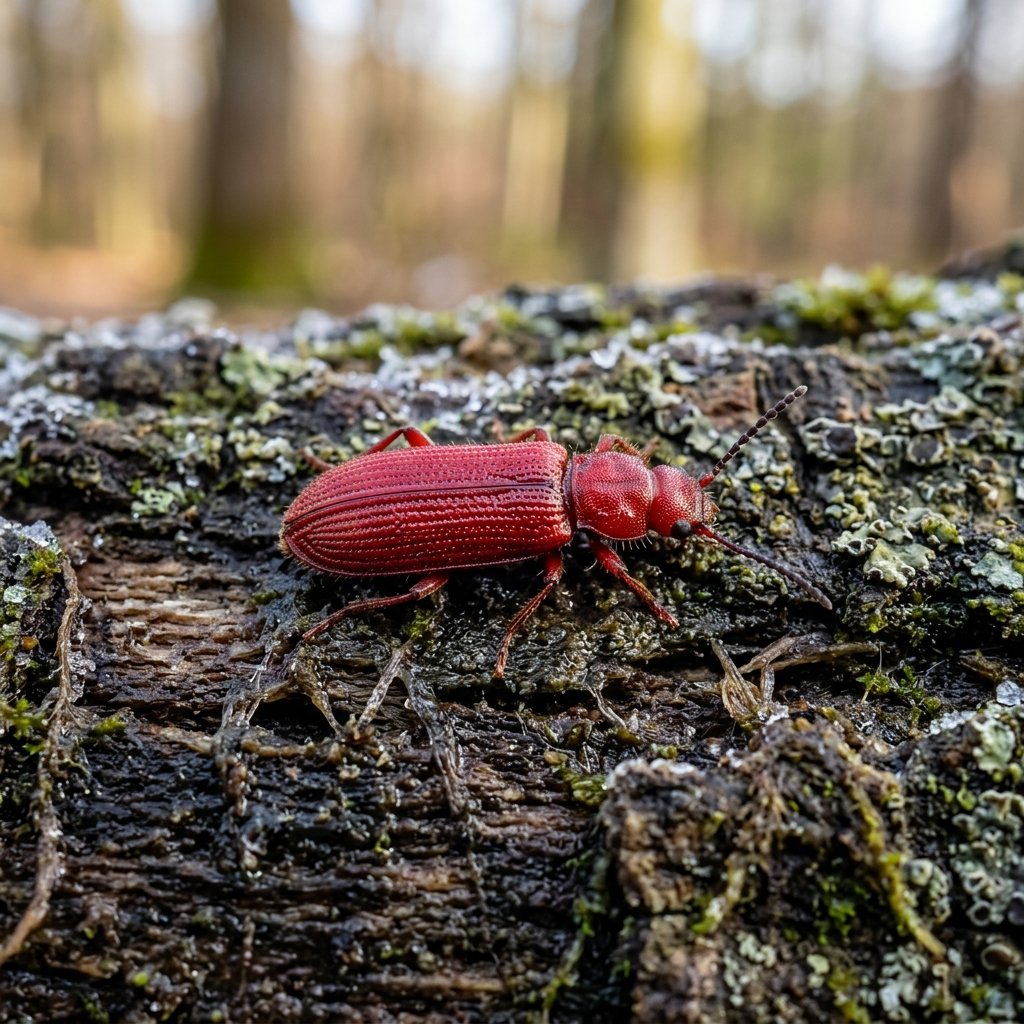
The Red Flat Bark Beetle (Cucujus clavipes) is a striking scarlet insect that looks as though it was accidentally pressed between the pages of a heavy book. Often found hiding in the narrowest crevices of the forest, this beetle is a master of the "squeeze," using its ultra-thin body to navigate a world only a few millimeters wide. Beyond its vivid color, it is a legendary survivor, capable of enduring some of the coldest temperatures on Earth.
🔍 How to Identify
- 🔴 The Body: A brilliant, saturated crimson or scarlet color across the entire upper surface, making it stand out vividly against dark wood.
- 📐 Paper-Thin Profile: An extremely flattened, rectangular body shape designed specifically to slide under tight layers of tree bark.
- 🪲 Head & Jaws: A broad, triangular head featuring prominent, dark mandibles (jaws) and antennae that look like tiny strings of black beads.
🌲 Habitat & Ecology
- 🍂 The Tight Squeeze: These beetles live in the "sub-cortical" zone—the cramped space between the bark and the wood of dead or dying deciduous and coniferous trees.
- 🍴 Predatory Larvae: While the adults are often scavengers, the larvae are formidable hunters in their hidden world, using their own flattened bodies to chase down other small insects living under the bark.
- ❄️ Extreme Insulation: They are vital components of the forest ecosystem, helping to break down decaying wood and control the populations of other wood-boring pests.
⚠️ Safety & Toxicity
- ✅ Harmless Neighbor: The Red Flat Bark Beetle is completely non-toxic and poses no threat to humans. It does not possess a stinger or venom.
- 🛡️ Gentle Nature: Although their mandibles look intimidating, they are not aggressive toward people or pets. They are "forest friends" that prefer to stay hidden and will simply try to scuttle into a crack if discovered.
✨ Fun Fact
This beetle is a biological marvel! To survive frigid North American winters, it produces high concentrations of "antifreeze" proteins and glycerol in its blood. This allows it to undergo a process called vitrification—essentially turning into a living glass—which lets it survive temperatures as low as -58°F (-50°C) without freezing solid!
More Details








