Info
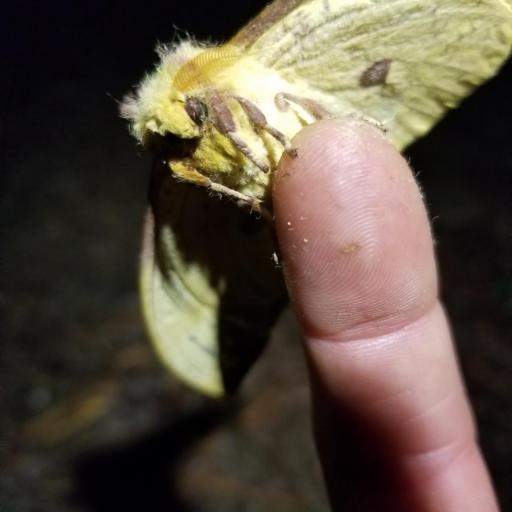
Often mistaken for a fallen autumn leaf, the Imperial Moth (Eacles imperialis) is a majestic giant of the night. These fuzzy titans are celebrated by naturalists for their impressive wingspan and the stunning, "regal" patterns that look like spilled wine on a yellow cloth. While their caterpillars can look like tiny, spiked dragons, they are gentle giants that play a vital role in the woodland ecosystem.
🔍 How to Identify
- 🦋 The Wings: Massive (up to 7 inches across), featuring a bright buttery-yellow base color heavily mottled with splotches of "imperial" purple or rusty brown.
- 🧶 The Texture: They have incredibly thick, furry bodies and feathered antennae, which they use like high-tech sensors to find mates in the dark.
- 🐛 The Larvae: The caterpillars are highly variable; they can be neon green, burnt orange, or almost black, decorated with white "breathing holes" and intimidating (but soft) bristles.
🌲 Habitat & Ecology
- 🌳 Forest Dwellers: You will most likely find them near their favorite "host" trees, such as Maples, Oaks, Pines, and Walnuts, where the females carefully glue their eggs to the undersides of leaves.
- ⏳ A Brief Brilliance: As adults, Imperial Moths have no mouthparts and cannot eat. Their entire adult life—usually only a week—is fueled by energy stored from their time as a caterpillar, dedicated solely to finding a mate.
⚠️ Safety & Toxicity
- ✅ Completely Harmless: Neither the moth nor the caterpillar is toxic to humans or common household pets.
- 🚫 Look, Don't Touch: While the caterpillar's horns look like they might sting, they are purely for show to scare off birds. However, the caterpillar's skin can be sensitive, so it is best to let them crawl onto a stick rather than handling them directly.
✨ Fun Fact
Imperial Moth caterpillars are famous for their "color polymorphism." Even from the same batch of eggs, some siblings will grow up bright green while others become dark chocolate brown, a clever evolutionary trick to ensure at least some of them blend into different parts of the tree!
More Details








