Info
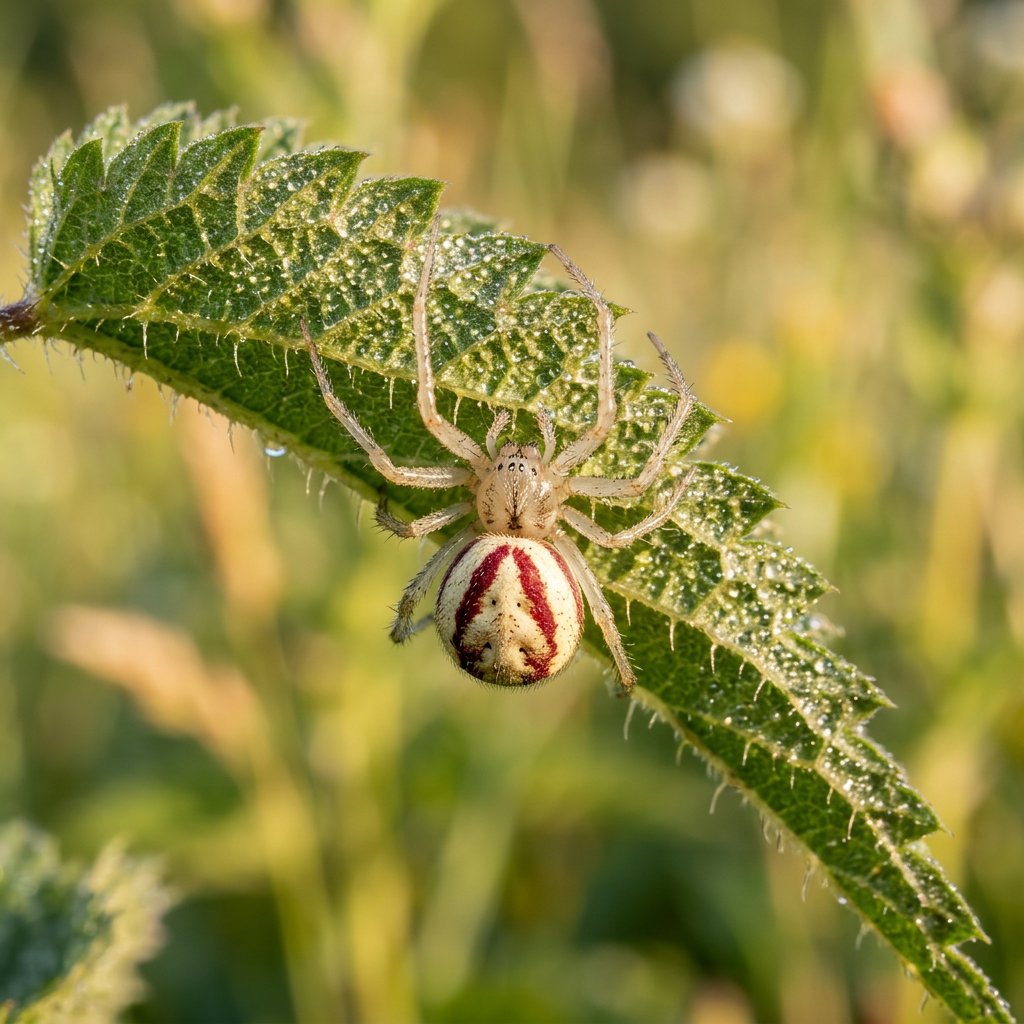
Meet the "Candy-striped Spider," one of nature's most festive-looking arachnids. Often mistaken for a drop of spilled paint or a piece of candy among the leaves, this little predator is a master of disguise and a helpful garden ally. While its bright colors might look like a warning, it is actually a shy, harmless resident of the shrubbery that spends its life tucked away in secret green corners.
🔍 How to Identify
- 🎨 Abdomen Patterns: It has a round, bulbous abdomen that is usually cream, white, or pale yellow. It typically features two bright crimson longitudinal stripes, though some individuals may have a solid red block or no red at all.
- 🦵 Translucent Legs: Its legs are long, thin, and almost see-through, often marked with distinct dark spots or tiny black bands at the "knee" joints.
- 🎀 The "Comb" Feet: As a member of the cobweb spider family, it has tiny serrated bristles on its fourth pair of legs used for throwing sticky silk over its prey.
🌲 Habitat & Ecology
- 🍃 The Leaf Architect: Rather than sitting in the middle of a flat web, this spider prefers to live inside a "retreat." It uses its silk to curl a leaf into a loose tent, providing a safe nursery and a hiding spot from hungry birds.
- 🦟 Garden Guardian: It is a generalist predator, feeding on aphids, small flies, and even insects larger than itself that bumble into its messy, three-dimensional tangle of silk.
- 🕸️ Low Vegetation: You will most likely spot them in hedges, brambles, and garden shrubs, usually at waist height or lower.
⚠️ Safety & Toxicity
- ✅ Status: Harmless: The Candy-striped Spider is a non-aggressive species that poses no threat to humans. It is far more likely to play dead or run away than to bite.
- 🐾 Pets & Kids: It is safe to have in the garden. Its fangs are generally too small to penetrate human or pet skin, and its venom is not medically significant.
✨ Fun Fact
This spider is a classic example of "polymorphism." It comes in three distinct color versions (plain yellow, two-striped, or one-red-stripe), and these variations are purely genetic—similar to how humans have different hair colors!
More Details








