Info
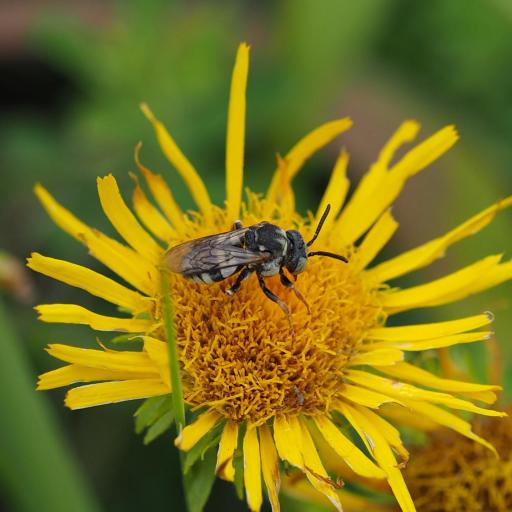
Known as the Variegated Cuckoo Bee, this striking insect is the "pirate" of the garden world. Unlike the hardworking honeybees we often imagine, this species lives a life of stealth and opportunism. With its bold, marbled markings, it looks more like a designer accessory than a typical fuzzy bee.
🔍 How to Identify
- 🎨 Felted Patterns: Its jet-black body is decorated with distinct, bright white or cream-colored patches of short, "felt-like" hairs that look like intricate embroidery.
- 🦵 Russet Highlights: A key giveaway is the color of its legs and the base of its antennae, which are usually a rich, reddish-orange or brownish hue.
- 🐝 Compact Silhouette: It lacks the long, shaggy hairs of "pollen-collecting" bees because it doesn't need to carry supplies. It has a sturdy, slightly armored look with a blunt-tipped abdomen.
🌲 Habitat & Ecology
- 🏴☠️ The Cuckoo Lifestyle: Just like the Cuckoo bird, this bee is a "cleptoparasite." It waits for a Cellophane Bee (Colletes species) to leave its underground nest, then slips inside to lay its own egg on the host's hard-earned pollen stores.
- 🌸 Sun-Seekers: You are most likely to spot them in sunny, sandy areas or flowery meadows. While the larvae are "thieves," the adults are peaceful nectar-drinkers that frequent Ragwort, Wild Carrot, and Fleabane.
⚠️ Safety & Toxicity
- 🛡️ Non-Aggressive: Despite its wasp-like appearance, the Variegated Cuckoo Bee is not aggressive. It is a solitary insect with no hive or queen to defend.
- 🧤 Handle with Care: Females do possess a small stinger, but they will only use it if they are physically squeezed or stepped on. The sting is generally mild and far less painful than that of a social wasp or honeybee.
✨ Fun Fact
The first-stage larva of the Variegated Cuckoo Bee is born with massive, sickle-shaped mandibles. It doesn't use these for eating; it uses them to "dispatch" the host's egg or larva to ensure it has all the food for itself!
More Details








