Info
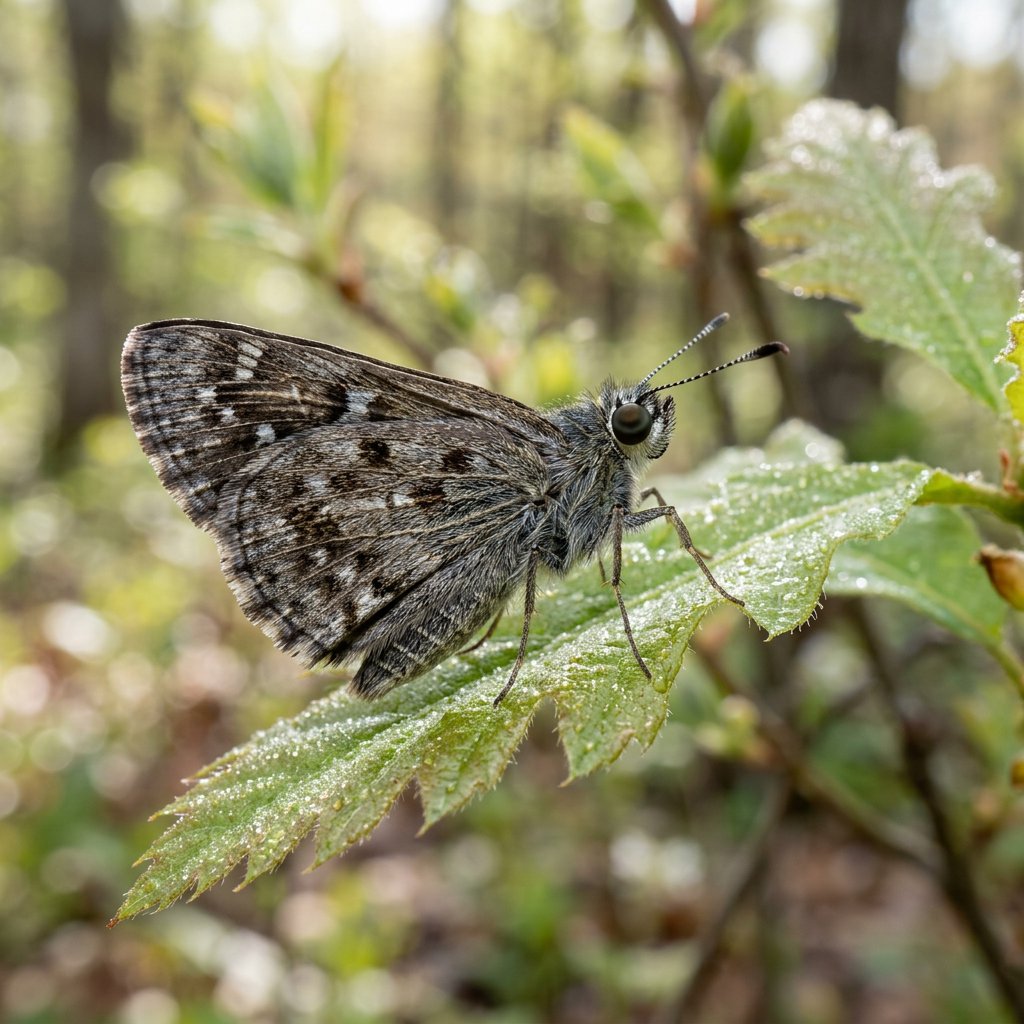
Commonly known as the Juvenal’s Duskywing, this subtle beauty is often mistaken for a moth due to its earthy, camouflaged wings. It is one of the first heralds of spring in North American woodlands, darting through oak groves before the canopy fully closes. Despite its "dusty" appearance, it is a master of aerial acrobatics and a key member of the skipper butterfly family.
🔍 How to Identify
- 🦋 The Wings: Primarily dark brown with intricate gray and black mottling. Look closely for two to four tiny, translucent white spots near the tip of the forewing.
- 🪵 Underwing Pattern: The underside of the hindwing typically features two distinct pale spots near the outer edge, a key detail that helps experts tell it apart from its "twin," the Horace’s Duskywing.
- 🧶 Body Texture: It possesses a stout, notably "furry" body and large eyes, giving it a soft, moth-like appearance that helps it retain heat during cool spring mornings.
🌲 Habitat & Ecology
- 🌳 The Oak Connection: These butterflies are oak specialists. Their caterpillars feed almost exclusively on the leaves of various oak species, meaning you will almost always find the adults patrolling the edges of oak-hickory forests.
- 💧 Puddling Behavior: You may spot males gathered in groups on damp soil or mud. This behavior, called "puddling," allows them to drink mineral-rich water, which provides essential salts needed for successful mating.
- 🌸 Dietary Habits: As adults, they are frequent visitors to low-growing spring flowers. They are particularly fond of blueberries, wild plums, and dandelions, acting as efficient pollinators for these early bloomers.
⚠️ Safety & Toxicity
- ✅ Harmless: The Juvenal's Duskywing is completely safe for humans, children, and pets. They do not bite, sting, or possess any chemical defenses.
- 🍃 Ecosystem Indicator: Because they rely so heavily on specific oak habitats, their presence is a sign of a healthy, mature woodland ecosystem. They are sensitive to heavy pesticide use, so seeing them in your yard is a compliment to your local environment.
✨ Fun Fact
The Juvenal's Duskywing is "univoltine," meaning it only has one single generation per year. While other butterflies might be seen all summer, these "spring ghosts" appear for only a few weeks in the early season before vanishing until the following year.
More Details








