Info
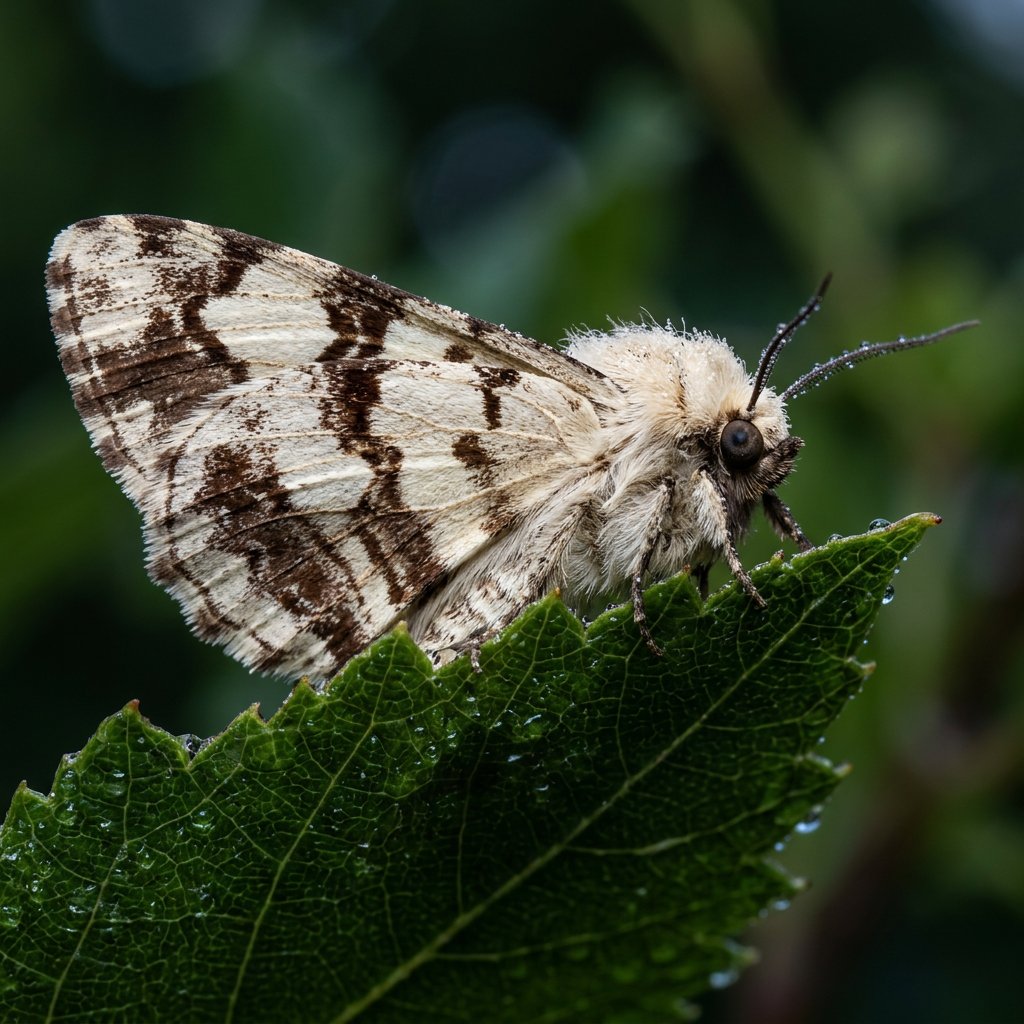
Known as the Beautiful Wood-Nymph, this moth is one of nature’s most impressive camouflage artists. While its name sounds elegant, its survival strategy is famously "gross"—it has evolved to look exactly like a fresh bird dropping to hide in plain sight on green leaves. Found across North America, it is a master of disguise that proves beauty (and safety) is in the eye of the beholder.
🔍 How to Identify
- 🦋 The Wings: The forewings are a creamy, chalky white with a thick, irregular border of reddish-brown and deep purple, often featuring a subtle metallic sheen.
- ☁️ The Body: It possesses a very "fluffy" appearance, particularly around the head and thorax, which are covered in dense white and yellow hairs.
- 🍗 The Legs: When resting, it often extends its front legs, which are heavily tufted with orange and black scales, making them look like small bits of debris.
- 📐 Resting Posture: It holds its wings in a steep, roof-like shape over its back, a silhouette that perfectly mimics a splash of bird excrement on a leaf.
🌲 Habitat & Ecology
- 🍇 The Caterpillar Diet: The larvae are striking, featuring bright orange and black stripes. They are primarily found munching on wild grapes, Virginia creeper, and hops.
- 🌙 Night Owl: As a nocturnal moth, it spends its nights pollinating flowers and its days hiding on the upper surfaces of leaves, relying entirely on its "unappetizing" disguise to avoid being eaten by birds.
- 🏡 Garden Presence: You are most likely to spot one in woodland edges or suburban gardens that have plenty of climbing vines and dense foliage.
⚠️ Safety & Toxicity
- ✅ Harmless: The Beautiful Wood-Nymph is a "friend" to gardeners and poses no threat to humans or pets.
- 🚫 No Sting: Unlike some fuzzy caterpillars, the larvae of this moth do not have stinging hairs or venom. They are perfectly safe to observe closely, though they are best left on their host plants to complete their lifecycle.
✨ Fun Fact
The "bird dropping" camouflage is so effective that even experienced entomologists often walk right past them. This specific type of mimicry is called masquerade, where an organism evolves to look like an inedible, inanimate object rather than a different animal!
More Details








