Info
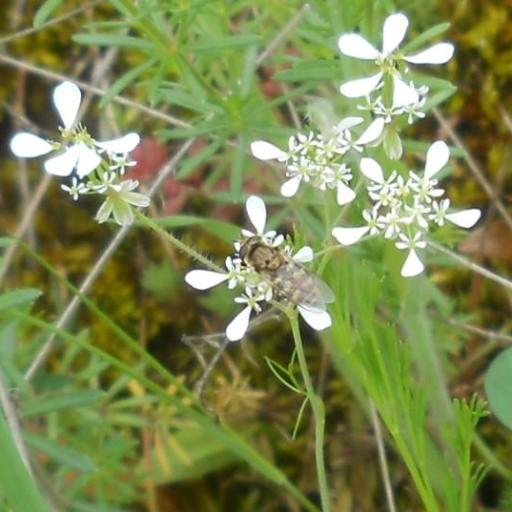
Often called the Migrant Hoverfly, this tiny aviator is a master of disguise and a true champion of the garden. While it wears the bright "danger colors" of a wasp to scare off hungry birds, it is actually a gentle pollinator and one of the most effective organic pest controllers nature has to offer. These insects are famous for their incredible marathon flights, often traveling hundreds of miles across seas and mountains to find the perfect meadow.
🔍 How to Identify
- 🟡 Comma Markings: Look closely at its black abdomen; it features distinct yellow, comma-shaped bands that often extend all the way to the side edges of the body.
- 👀 Wraparound Eyes: Like most hoverflies, it has massive, reddish-brown eyes that cover most of its head, giving it an almost "alien" appearance and incredible flight precision.
- 🚁 Stationary Flight: It is easily recognized by its behavior—hanging perfectly still in mid-air like a miniature drone before darting away in a blur of speed.
🌲 Habitat & Ecology
- 🐜 The Aphid Hunter: While the adults spend their days sipping nectar, their larvae are fierce predators. A single larva can devour hundreds of aphids, making them a gardener's secret weapon against pests.
- 🌍 World Traveler: This species is highly migratory. In some parts of the world, they are known to fly in massive swarms across the ocean, following seasonal blooms to ensure their offspring have enough food.
⚠️ Safety & Toxicity
- 🛡️ Complete Mimicry: Don't let the stripes fool you! The Migrant Hoverfly has no stinger and no venom. It is a "Batesian mimic," meaning it only pretends to be dangerous to stay safe.
- 🐾 Pet & Child Friendly: They are entirely harmless to humans, dogs, and cats. They do not bite and are generally quite bold, sometimes even landing on a person's hand to sip a bit of salty sweat.
✨ Fun Fact
A single Eupeodes corollae larva is a biological eating machine, capable of consuming up to 1,000 aphids before it finally transforms into its winged adult form!
More Details








