Info
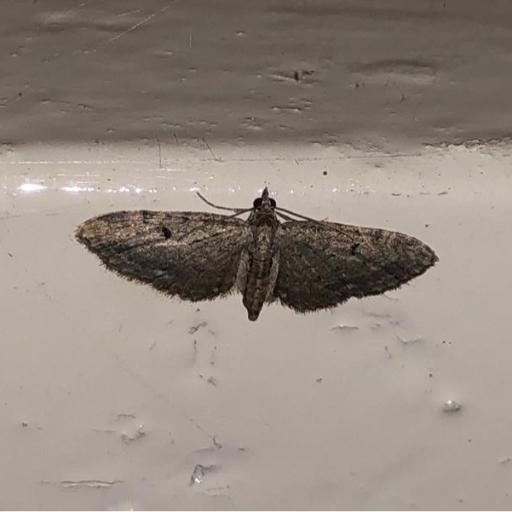
Known as the Goldenrod Pug, this tiny moth is a master of camouflage that blends perfectly into the bark of trees and the shadows of foliage. While its muted colors might make it seem like a "gray ghost" of the garden, it plays a vital role in the ecosystem as both a pollinator and a food source for nocturnal hunters like bats. It is one of the many "Pug" moths, a group named for their small size and pushed-in, flattened appearance when resting.
🔍 How to Identify
- 🦋 Resting Posture: Unlike many moths that fold their wings like a tent, the Goldenrod Pug rests with its wings spread flat against a surface, creating a distinct "T" or triangular shape.
- 🎨 Wing Pattern: The forewings are primarily grayish-brown with subtle, wavy cross-lines and a small, prominent dark spot (the discal spot) near the center of each wing.
- 📏 Small Stature: It is quite petite, typically sporting a wingspan of only 17 to 20 millimeters, making it easy to miss if you aren't looking closely.
🌿 Habitat & Behavior
- 🌼 Floral Diet: While many moth caterpillars munch on leaves, the Goldenrod Pug larvae are specialists that prefer to eat the flowers and developing seeds of Goldenrod (Solidago) and Ragwort (Senecio).
- 🌙 Night Owl: The adults are strictly nocturnal and are frequently drawn to garden light traps or porch lights during their two flight periods (typically May-June and again in August).
- 🏡 Garden Presence: You are most likely to find them in open woodlands, waste grounds, and gardens where yellow composite flowers are allowed to grow wild.
⚠️ Safety & Toxicity
- 🛡️ Status: Completely harmless and non-aggressive.
- 🐾 Details: This moth does not possess a stinger, nor are its caterpillars known to have irritating hairs. It poses no threat to humans, dogs, or cats and is a sign of a healthy, biodiverse backyard.
✨ Fun Fact
The Eupithecia genus, to which this moth belongs, is famously difficult for entomologists; many species look so similar that they are known as "the heartbreaks" of the moth-watching world because they often require a microscope to tell apart!
More Details








