Info
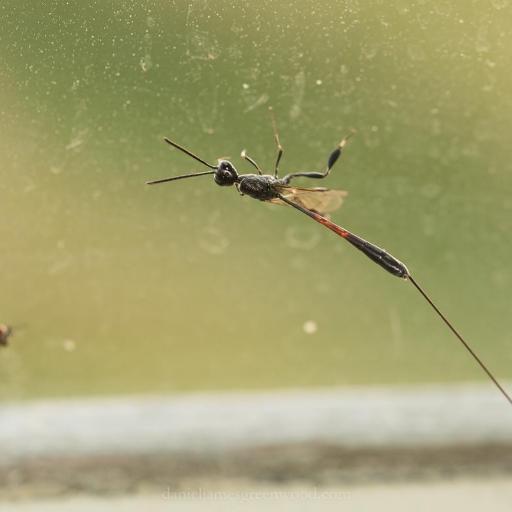
Despite the "plant" label, Gasteruption jaculator is actually a fascinating, slender insect often found hovering over garden blooms. Frequently called the Carrot Wasp, this delicate creature looks like a living needle or a tiny, hovering crane. It is a master of stealth, playing a vital role in the natural balance of your garden's ecosystem by keeping other insect populations in check.
🔍 How to Identify
- 🦟 The "High-Rise" Abdomen: Unlike most wasps, its abdomen is attached very high on its thorax (the middle section), giving it a distinctive "tilted" or "cranked" silhouette while in flight.
- 📍 The Long Tail: Females possess a remarkably long, needle-like ovipositor that can be as long as their entire body. It is often tipped with a tiny white speck.
- 🦴 Clubbed Legs: If it lands, you’ll notice its hind legs are strangely thickened or "swollen" at the ends, contrasting with its otherwise spindly, thread-like frame.
🌲 Habitat & Ecology
- 🌼 Floral Favorites: You will most likely spot them visiting umbrella-shaped white flowers (umbellifers) like Wild Carrot, Fennel, or Cow Parsley, where they sip nectar for energy.
- 🏠 The Nest Raider: These are "parasitoid" wasps. They spend their time scouting for the nests of solitary bees (like Mason or Leafcutter bees) in old stone walls, dead wood, or "bee hotels" to lay their eggs.
- 🕵️ Aerial Reconnaissance: They are famous for their slow, bobbing flight pattern. They hover patiently in front of small holes in wood, "sniffing" out the perfect spot to deposit their offspring.
⚠️ Safety & Toxicity
- 🛡️ Status: Completely harmless "Friend."
- 🧘 All Bark, No Bite: Although the female’s long tail looks like a terrifying stinger, it is strictly a tool for egg-laying and cannot pierce human skin. They are not aggressive and pose no threat to children or pets.
- 🐝 Bee Hotel Guest: While they are harmless to humans, they do prey on solitary bees. If you have a bee hotel, seeing these wasps is a sign of a high-functioning, diverse backyard ecosystem!
✨ Fun Fact
The female Gasteruption jaculator is a precision engineer; she uses her long "tail" to drill through the hard mud plugs or resin seals that solitary bees build to protect their young, ensuring her own larvae have a safe place to grow.
More Details








