Info
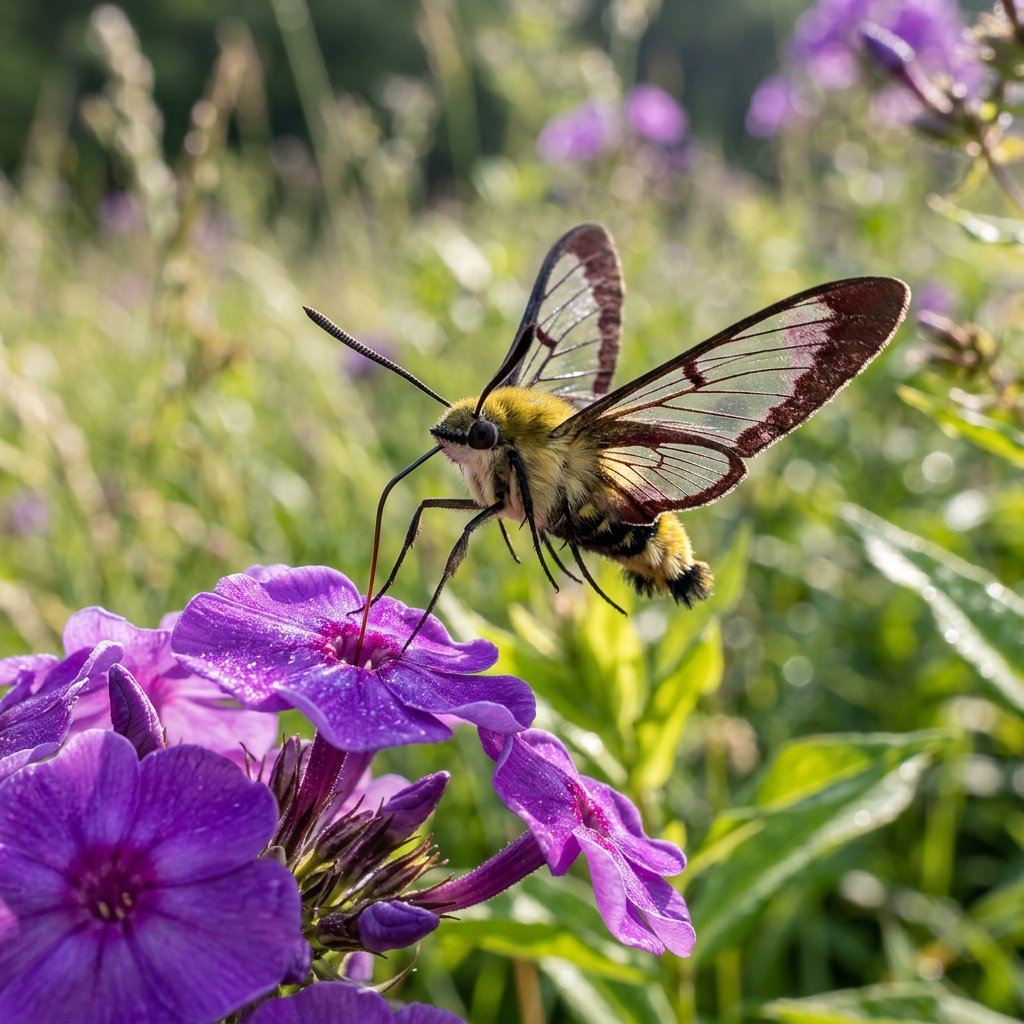
Meet the great impostor of the summer garden! Often mistaken for a tiny hummingbird or a fuzzy bumblebee, the Snowberry Clearwing (Hemaris diffinis) is actually a master of disguise. This day-flying moth uses its remarkable speed and "bee-like" appearance to deter predators while it zips from flower to flower, sipping nectar in broad daylight.
🔍 How to Identify
- 🦋 The Wings: Unlike most moths, their wings are largely transparent with a dark, reddish-brown border. They look like stained glass when they catch the sunlight.
- 🐝 The Body: They are covered in thick, hairlike scales that create bright yellow and black bands, perfectly mimicking the warning colors of a bumblebee.
- 👅 The Proboscis: Look for a very long, straw-like tongue that they extend to reach deep into tubular flowers while hovering mid-air.
🌲 Habitat & Ecology
- 🌸 Nectar Lovers: You’ll find them in open meadows, suburban gardens, and forest edges. They are particularly fond of Bee Balm, Phlox, and Honeysuckle.
- 🍃 Host Plants: While the adults are generalists, the caterpillars are pickier. They rely on Snowberry bushes, Honeysuckle, and Dogbane to grow, blending in perfectly with the green leaves.
- 🕊️ Hovering Flight: Their flight pattern is unique; they move with the jerky, precise hovering motions of a hummingbird, making them a joy (and a challenge) to photograph.
⚠️ Safety & Toxicity
- 🛡️ The Big Bluff: Despite their convincing "bee" costume, Snowberry Clearwings are completely harmless. They have no stinger and cannot bite.
- 🐾 Pet & Human Safety: They are non-toxic to touch and pose no threat to curious cats or dogs. Their only defense is their "scary" look, which is a classic example of Batesian mimicry.
✨ Fun Fact
When these moths first emerge from their cocoons, their wings are actually covered in dark scales like a normal moth. However, upon their very first flight, those scales quickly fall off, leaving behind the iconic "clear" windows that give them their name!
More Details








