Info
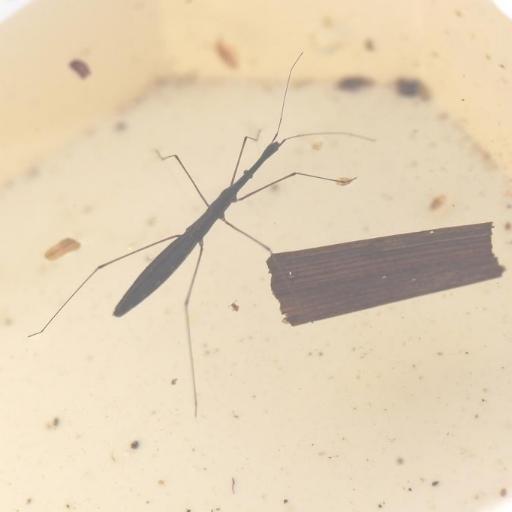
Commonly known as the Water Measurer, this slender insect is a master of patience and precision. Often mistaken for a tiny, floating twig, it spends its life navigating the surface tension of still waters with a slow, deliberate gait. It belongs to a unique group of "surface film" dwellers that look more like stick insects than traditional water bugs.
🔍 How to Identify
- 📏 The Body: Exceptionally thin and needle-like, usually dark brown or charcoal grey, reaching about 10–13mm in length.
- 🦒 The Head: Features a disproportionately long, slender snout with eyes positioned curiously far back, nearly halfway down the head.
- 👣 The Legs: Six spindly, hair-thin legs that distribute its weight so perfectly it can walk across the water's surface without breaking the "skin" of the pond.
🌲 Habitat & Ecology
- 💧 Slow-Motion Living: You will find them in stagnant or very slow-moving water, such as garden ponds, ditches, and the weedy edges of lakes. They prefer to lurk among reeds and floating vegetation.
- 🍴 The Tiny Predator: They are stealthy hunters. Using their sensitive feet to detect vibrations, they find mosquito larvae or water fleas just beneath the surface and use their straw-like mouthparts to "sip" their meal.
- 🚶 The Gait: Unlike the common Water Strider which "skates" or leaps rapidly, the Water Measurer moves with a slow, rhythmic walking motion, hence its name.
⚠️ Safety & Toxicity
- ✅ Harmless Friend: This insect is completely safe for humans and pets. It does not bite, sting, or carry diseases.
- 🦟 Garden Ally: They are actually beneficial for your backyard ecosystem as they help naturally control mosquito populations by snacking on their larvae.
✨ Fun Fact
The Water Measurer is covered in thousands of tiny, water-repellent hairs. If it accidentally gets pushed underwater, these hairs trap a thin layer of air against its body, acting like a "physical gill" that allows it to breathe until it can climb back onto the surface!
More Details








