Info
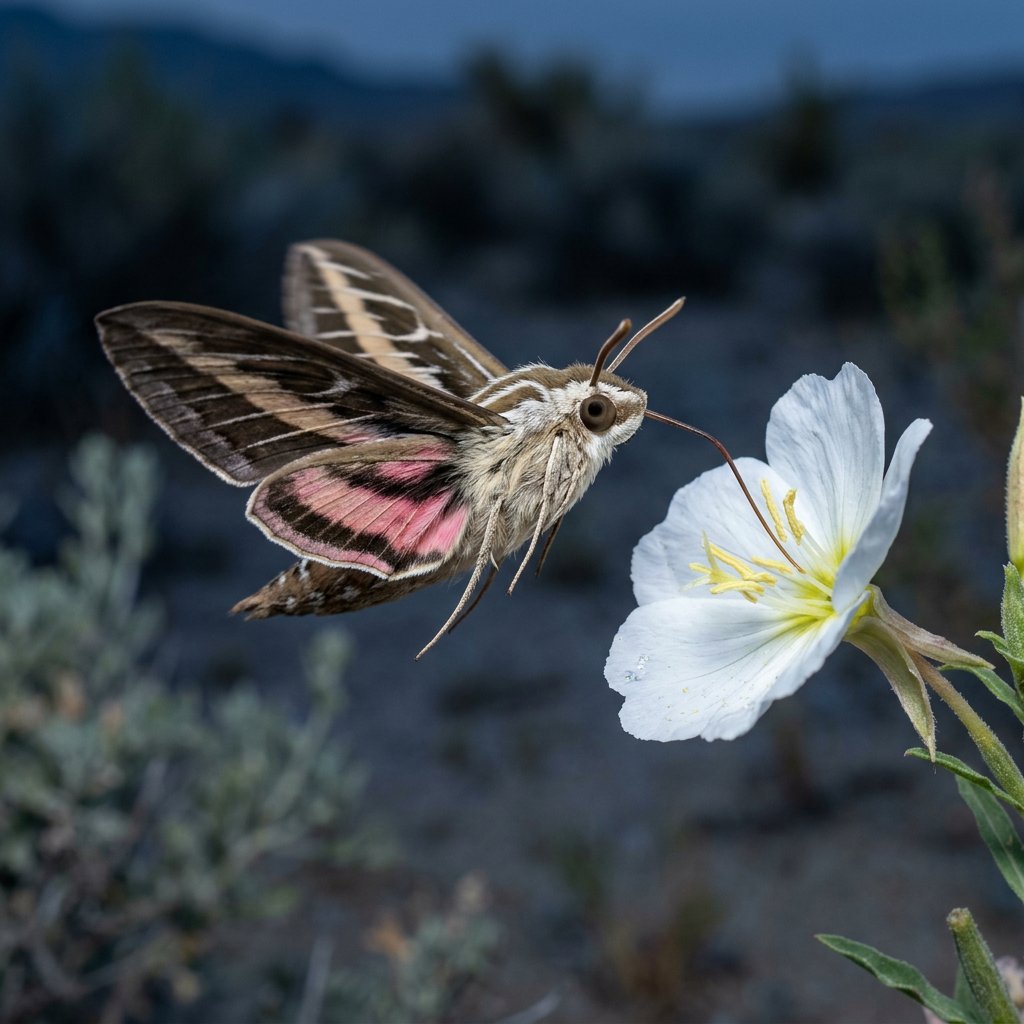
Often called the "Hummingbird Moth," the White-lined Sphinx (Hyles lineata) is a master of mimicry and a delight for evening gardeners. If you see a small, blurred creature hovering over your flowers at dusk, look closer—it’s likely this remarkable moth rather than a bird. They are one of the most widespread and recognizable moths in North America, acting as a vital link in the local ecosystem.
🔍 How to Identify
- 🦋 The Wings: Broad, olive-brown forewings marked with a distinct, thick tan stripe running diagonally and delicate white veins.
- 🌸 Hidden Color: When they take flight, they reveal a stunning flash of bright rosy-pink on their hindwings, a feature that distinguishes them from other sphinx moths.
- 🐝 The Body: They possess a stout, furry, aerodynamic body with six pairs of small white stripes on the abdomen, giving them a fuzzy, almost bee-like appearance.
🌲 Habitat & Ecology
- 🌻 The Evening Pollinator: While many moths are strictly nocturnal, the White-lined Sphinx is crepuscular, meaning it is most active at dawn and dusk. They use a remarkably long proboscis (tongue) to sip nectar from deep-throated flowers like Petunias, Honeysuckle, and Moonflowers.
- 🐛 The Hornworm Phase: Before they take to the sky, they are large, lime-green or black caterpillars known as "hornworms." They are famous for their "horn" on the tail end and their ability to travel in massive groups across roads and fields during population booms.
⚠️ Safety & Toxicity
- 🛡️ Status: Completely Harmless.
- 🚫 Details: These moths have no mechanism to bite or sting. Even the formidable-looking "horn" on the caterpillar is soft and flexible, used only as a visual bluff to scare away birds. They are perfectly safe for curious children and pets to observe.
✨ Fun Fact
✨ Speed Demons: The White-lined Sphinx moth is one of the fastest insects in the garden, capable of reaching flight speeds of up to 30 miles per hour—fast enough to outpace most human joggers!
More Details








