Info
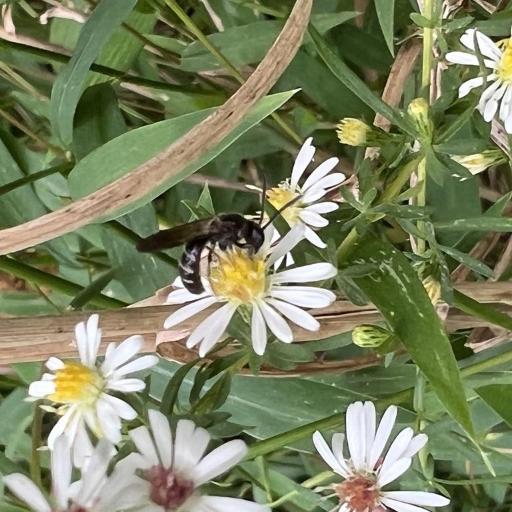
Meet the Brown-winged Sweat Bee, a tiny, shimmering unsung hero of the meadow. Often overlooked because of their diminutive size, these bees belong to the Halictidae family—a group famous for their curious habit of landing on human skin to sip on salty perspiration. Far from being pests, these "garden ghosts" are tireless pollinators that keep your local ecosystem humming quietly in the background.
🔍 How to Identify
- 🪽 Dusky Wings: As the name fuscipenne suggests, their wings have a distinct brownish or "smoky" tint, setting them apart from the crystal-clear wings of many other small bees.
- 🕵️ Compact Frame: They are quite small, often measuring less than 10mm. To the untrained eye, they can easily be mistaken for flying ants or tiny dark flies.
- ✨ Subtle Metallic Sheen: While some sweat bees are neon green, this species has a more sophisticated, dark metallic body—usually black or deep charcoal with a faint oily luster when the sun hits them.
🌲 Habitat & Ecology
- 🕳️ Subterranean Architects: You won't find these bees in hanging hives. They are ground-nesters, excavating vertical tunnels in bare, well-drained soil. They often prefer sunny patches of earth where they can keep their brood warm.
- 🌸 Generalist Pollinators: They aren't picky eaters! They visit a massive variety of flowers, from common garden weeds to high-end ornamental blooms, making them one of the most important "all-purpose" pollinators in North America.
- 🤝 Semi-Social Life: This species is "primitively eusocial," meaning they live in small groups where daughters often stay to help their mothers, though they lack the rigid, complex hierarchy seen in honeybee colonies.
⚠️ Safety & Toxicity
- 🐝 Very Low Risk: Sweat bees are exceptionally gentle. They have no interest in humans and will only sting if they are physically crushed against your skin or stepped on with bare feet.
- 🩹 Mild Sting: On the rare occasion they do sting, the sensation is often described as a "tiny spark" or a "paper cut." It is far less painful than a wasp or honeybee sting and rarely causes significant swelling unless you have a specific allergy.
- 🧂 Salt Seekers: If one lands on your arm, it is likely just looking for a salt snack from your sweat. A gentle puff of air is usually enough to encourage them to fly away.
✨ Fun Fact
Unlike many bees that have a fixed social structure, some Lasioglossum species can actually switch their behavior! Depending on the climate and altitude, the same species might live as a solitary "loner" or form a cooperative colony, showing incredible evolutionary flexibility.
More Details








