Info
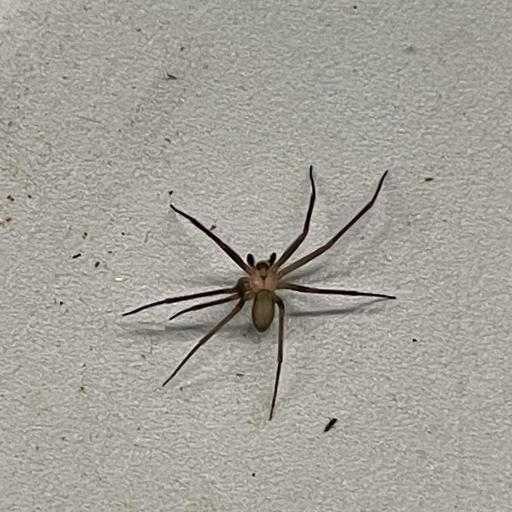
Often called the Fiddleback Spider or Violin Spider, the Brown Recluse is one of the most famous—and misunderstood—arachnids in North America. Despite its fearsome reputation, this spider is a shy, non-aggressive hermit that prefers the dusty shadows of a basement to any human interaction. While they are a "foe" due to their potent venom, they are far more interested in hiding than biting.
🔍 How to Identify
- 🎻 The Violin Mark: Look for a dark, violin-shaped silhouette on its "back" (the cephalothorax), with the "neck" of the violin pointing toward the spider's abdomen.
- 👀 Six Simple Eyes: Unlike most spiders that have eight eyes, the recluse has only six, arranged in three distinct pairs (dyads) in a semi-circle pattern.
- 🦵 Uniform Legs: Their legs are long, slender, and smooth. If the spider has thick spines or stripes on its legs, it is likely a common (and harmless) Wolf Spider or Grass Spider instead.
🌲 Habitat & Ecology
- 📦 The Secretive Resident: True to their name, they love "reclusive" spots. Indoors, they favor cardboard boxes, cluttered closets, and rarely-worn shoes. Outdoors, they hide under loose bark or in woodpiles.
- 🐜 Nocturnal Scavenger: They don't use a traditional web to catch food. Instead, they leave their retreats at night to hunt for small insects like silverfish and cockroaches, or even scavenge on recently dead bugs.
⚠️ Safety & Toxicity
- 🚫 Status: Venomous. The Brown Recluse possesses a hemotoxic venom that can cause necrotic skin lesions (tissue death).
- 🧤 Prevention is Key: They are not aggressive and usually only bite when pressed against skin (like when reaching into a dark box). Always wear gloves when cleaning out attics or garages, and shake out old boots or clothing that has been stored for a long time. If bitten, seek medical attention immediately.
✨ Fun Fact
The Brown Recluse is a master of survival; laboratory studies have shown that adult specimens can live for over six months without any food or water!
More Details








