Info
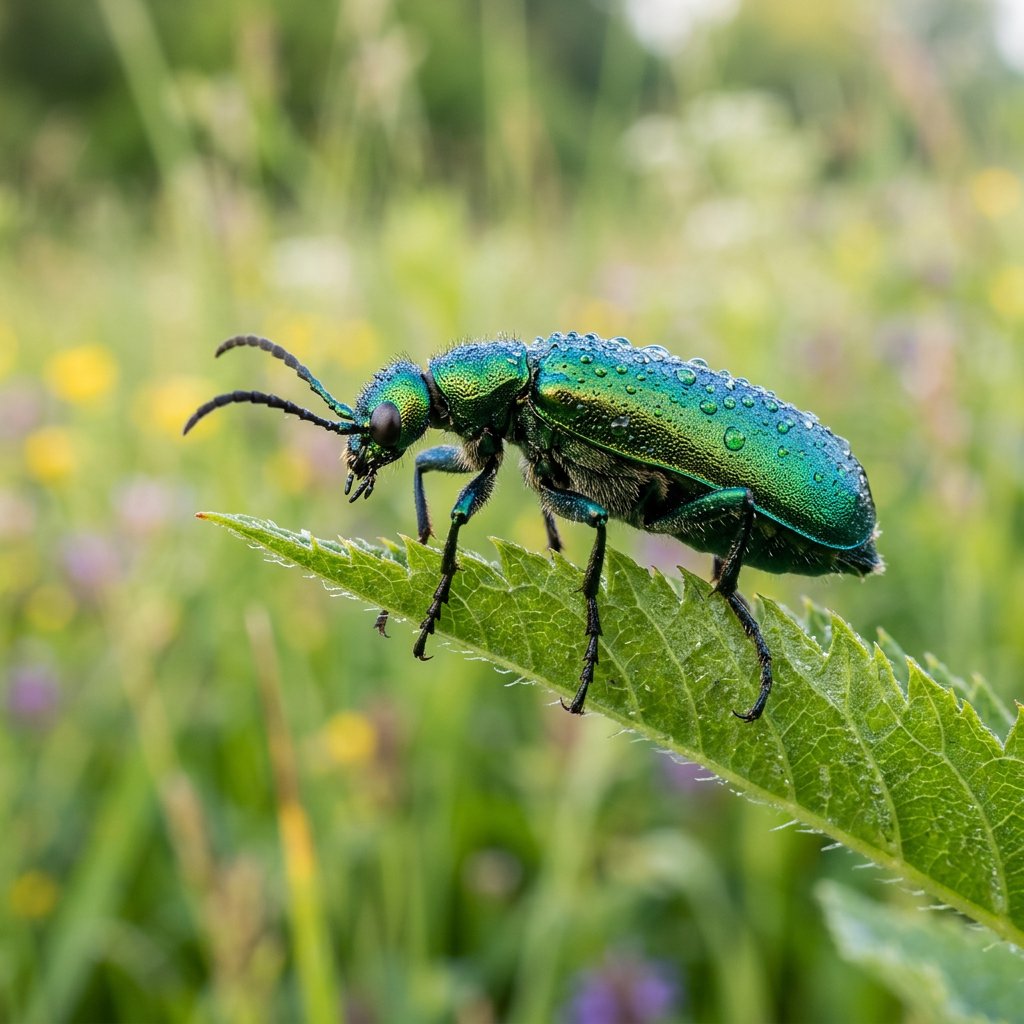
Known as the "Spanish Fly," this beetle is perhaps one of the most famous—and misunderstood—insects in history. Despite its name, it is actually a beautiful, iridescent blister beetle, not a fly. While it looks like a shimmering emerald jewel crawling through the leaves, it carries a potent chemical secret that has made it a legend in both ancient medicine and historical scandals.
🔍 How to Identify
- ✨ Metallic Sheen: A brilliant, uniform iridescent green or bronze-gold color that glimmers intensely under the sun.
- 🪲 Elongated Form: A slender, soft-bodied beetle measuring about 15 to 22 mm in length, with a relatively large head.
- 🛡️ Soft Wing Covers: Unlike the hard "crunchy" shells of most beetles, its wing covers (elytra) are flexible and smooth.
🌲 Habitat & Behavior
- 🍃 The Leaf Eater: You’ll mostly find adults high up in the canopy of Ash, Lilac, Privet, or White Willow trees, where they feast on the foliage during late spring and summer.
- 🐝 The Secret Hitchhiker: The larvae are parasites. They often wait on flowers for a ground-nesting bee to land, then hitch a ride back to the bee's nest to eat the bee's eggs and stored nectar.
- 💨 Odor Warning: When disturbed, these beetles can release a distinct, unpleasant mousy odor as a first-line warning to back off.
⚠️ Safety & Toxicity
- 🧪 Severe Blistering Agent: This beetle produces cantharidin, a powerful toxin. If the beetle is crushed or even lightly squeezed against the skin, it releases "reflex blood" that causes painful, fluid-filled blisters.
- 🚫 Dangerous if Ingested: Historically used as a dangerous "aphrodisiac," it is actually a violent poison. It should never be handled or ingested, as it can cause severe internal damage or even death.
- 🐾 Livestock Risk: It is a major concern for horse owners, as even a few beetles accidentally crushed into hay can be fatal to horses.
✨ Fun Fact
In the 18th century, the notorious Marquis de Sade was famously accused of giving "Spanish Fly" candies to guests at a party, leading to one of the most scandalous legal trials of his era. Modern medicine, however, has found a better use for the toxin: it is sometimes used by dermatologists today to safely "burn" off stubborn warts!
More Details








