Info
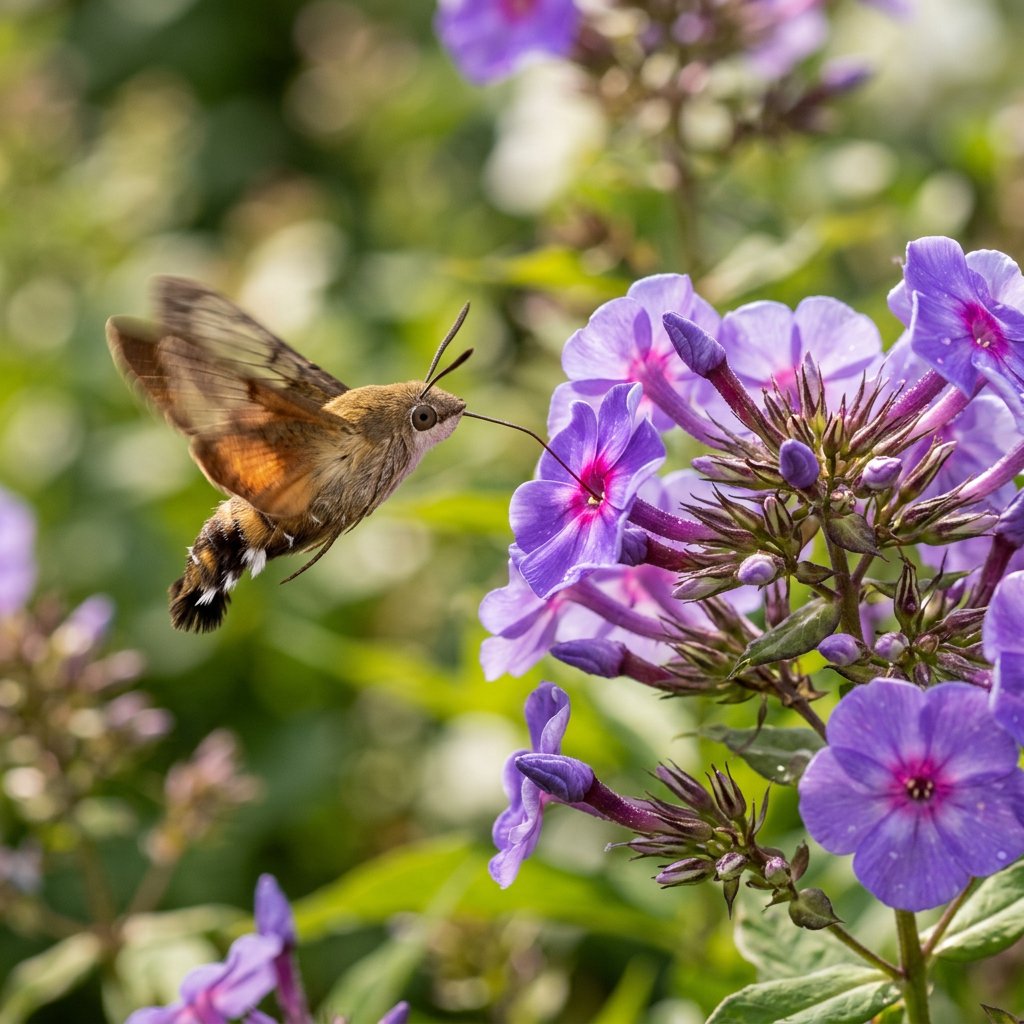
Often mistaken for a tiny, hovering bird, the Hummingbird Hawk-moth is a master of mimicry and one of the most charismatic visitors to a summer garden. While its name might lead some to look for a plant, this is a fascinating insect that defies typical "moth" behavior by being active in the brightest sunlight. Across Europe and Asia, it is celebrated as a sign of a healthy, nectar-rich ecosystem.
🔍 How to Identify
- 🦋 Wings: The forewings are a mottled gray-brown that provides perfect camouflage against bark, but when it flies, it reveals vibrant, hidden orange-gold hindwings.
- 🕵️ The "Tail": At the end of its stout body is a fan-shaped tuft of black and white hairs. This looks remarkably like bird feathers and acts as a rudder for its high-speed aerial acrobatics.
- 👅 The Proboscis: It possesses a remarkably long, straw-like tongue that is often longer than its entire body, allowing it to "hover-feed" without ever landing on a flower.
🌲 Habitat & Ecology
- 🌸 The Nectar Junkie: This moth has a high metabolism and needs a lot of fuel. It is particularly attracted to tubular flowers like Lavender, Honeysuckle, Buddleia (Butterfly Bush), and Jasmine.
- 🌍 A Long-Distance Traveler: They are incredible migrants. Some individuals fly hundreds of miles from North Africa and Southern Europe to reach northern climates, crossing seas and even mountain ranges to find fresh blooms.
- 🏠 Garden Role: They are highly efficient pollinators. Because they move so quickly between flowers, they transfer pollen across large areas faster than many species of bees.
⚠️ Safety & Toxicity
- ✅ Status: Completely harmless "friend" to gardeners and nature lovers.
- 🛡️ Defense: They have no stinger and do not bite. Their only defense is their incredible speed and their "scary" resemblance to a larger animal, which keeps predators like birds at a distance.
- 🐶 Pets: They are non-toxic to cats and dogs. While a cat might be tempted to chase the "whirring" visitor, the moth is usually far too fast to be caught.
✨ Fun Fact
- 👁️ Super Vision: Unlike many insects, the Hummingbird Hawk-moth has excellent color vision and can even see into the ultraviolet spectrum, helping it spot the most "sugar-heavy" flowers from a distance!
More Details








