Info
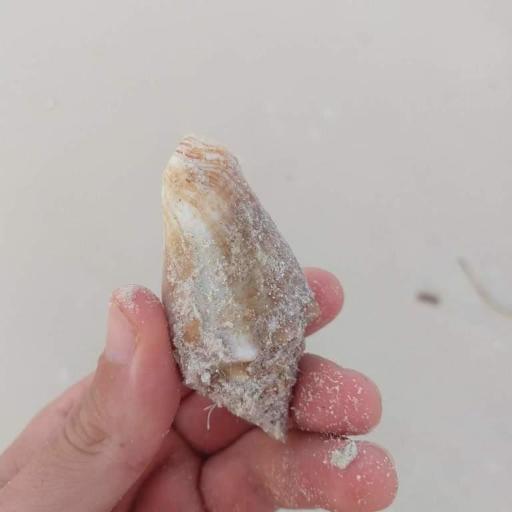
Known as the Milk Conch, this heavy-bodied marine snail is a classic treasure of the Caribbean. While its exterior might look like a rugged, weathered stone, the inside reveals a smooth, porcelain-white finish that gives it its "milky" name. Unlike its more famous relative, the Queen Conch, the Milk Conch is smaller and sturdier, built to withstand the tumbling waves of shallow sandy flats.
🔍 How to Identify
- 🐚 The Flared Lip: As the snail matures, it develops a thick, wing-like outer lip that flares outward, providing stability on the sandy ocean floor.
- 🥛 The Milky Aperture: The opening of the shell is coated in a glossy, creamy-white enamel, occasionally showing very faint tints of yellow or chrome.
- 🌀 Spired Crown: The top of the shell features a series of blunt, cone-like tubercles (bumps) that spiral upward, often encrusted with natural sea growth.
🌊 Habitat & Ecology
- 🌱 Seagrass Grazer: You will most likely find them in shallow "underwater meadows" or sandy reef flats, where they spend their days vacuuming up algae and organic debris.
- 🧗 The "Leaping" Foot: Unlike most snails that glide on a trail of slime, the Milk Conch moves using a "stromboid" motion—it uses its sharp, sickle-shaped trapdoor (operculum) like a mountaineer’s ice axe to vault itself forward in small hops.
⚠️ Safety & Toxicity
- ✅ Harmless: The Milk Conch is completely non-venomous and poses no threat to swimmers or beachgoers.
- 🐚 Handle with Care: While the animal is safe, the shell can be very heavy and the flared edges can be surprisingly sharp; always handle live specimens gently and return them to the water.
- 🚫 Conservation Check: In many regions, conchs are protected species. Always check local regulations before collecting "empty" shells, as they often serve as homes for hermit crabs.
✨ Fun Fact
The Milk Conch is a master of "pole-vaulting." When it senses a predator like a sea star nearby, it can use its muscular foot to perform rapid, erratic leaps to escape, making it one of the most athletic snails in the ocean!
More Details








