Info
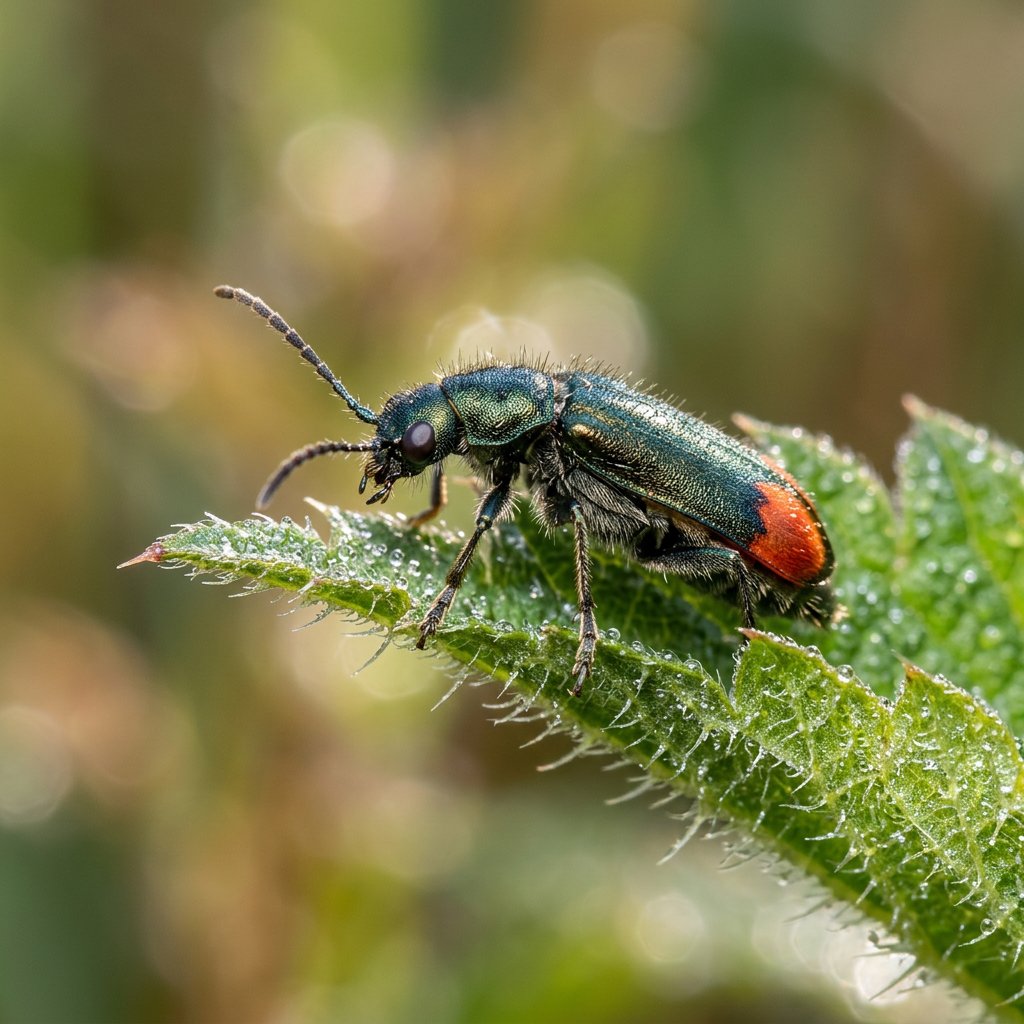
Often referred to as the Malachite Beetle, this tiny gem of the insect world is a frequent visitor to European and Asian gardens during late spring. With its shimmering metallic coat and distinctive red "tail lights," it looks more like a piece of living jewelry than a common beetle. It is a gardener’s friend, pulling double duty as both a delicate pollinator and a fierce tiny hunter.
🔍 How to Identify
- 🪲 The "Malachite" Shimmer: Its body is a brilliant, iridescent metallic green or bronze-green, which changes hue depending on how the sunlight hits it.
- 🔴 Red Tip Spots: The most defining feature is the pair of bright red or orange spots at the very tip of its soft wing cases (elytra), giving it the name bipustulatus (two-spotted).
- 🌿 Soft-Bodied Form: Unlike many "armored" beetles, this species belongs to the soft-winged flower beetle family; its wing covers are flexible and don't quite cover the very end of its abdomen.
- 🎭 Face & Antennae: They have dark, protruding eyes and serrated antennae. In males, the base of the antennae is uniquely thickened and shaped, used to signal to females.
🌲 Habitat & Ecology
- 🌸 The Flower Buffet: You will most likely find adults perched on daisies, buttercups, or umbellifers. They visit these flowers to feast on pollen and nectar, helping your garden thrive through pollination.
- ⚔️ A Tiny Predator: While the adults enjoy sweets, they are also opportunistic hunters that eat smaller soft-bodied insects. Their larvae are even more aggressive, living in old wood or thatch where they hunt for other insect larvae.
- ☀️ Sun Seekers: They are most active on warm, sunny days in May and June. If the clouds come out, they tend to hide deep within the petals or under leaves.
⚠️ Safety & Toxicity
- ✅ Harmless to Humans: The Malachite Beetle is completely safe for gardeners. It does not sting, and its mandibles are far too small to bite human skin.
- 🛡️ Chemical Defense: If it feels threatened by a bird or a larger predator, it can evert small, orange-red sacs from its sides. these emit a faint scent that signals to the predator that the beetle is not a tasty snack.
- 🐾 Pet Safety: They are non-toxic to cats and dogs, though their metallic shells might be a bit crunchy if accidentally swallowed!
✨ Fun Fact
During courtship, the male Malachite Beetle offers the female a "nuptial gift." He produces a special secretion from the base of his antennae; if the female finds the taste to her liking, she will accept him as a mate!
More Details








