Info
Meet the "Stealthy Giant" of the vegetable patch. Known most commonly as the Tomato Hornworm, this insect is a master of camouflage and a legendary foe to gardeners across North America. While the caterpillar is often feared for its appetite, the adult form—the Five-spotted Hawkmoth—is a spectacular, high-speed pollinator that many mistake for a hummingbird.
🔍 How to Identify
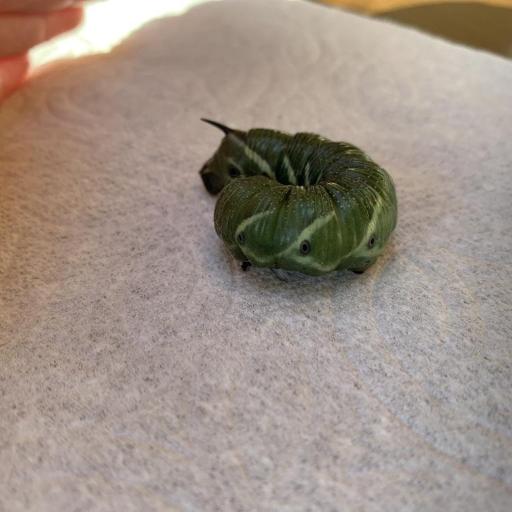
- 🐛 The Chevron Stripes: The caterpillar is bright green with eight white, V-shaped (chevron) markings along its sides. This distinguishes it from its close cousin, the Tobacco Hornworm, which has straight diagonal lines.
- 🦄 The False Stinger: It features a prominent, dark blue or black "horn" protruding from its rear end. Despite its fierce appearance, this horn is soft to the touch and cannot sting.
- 🦋 The Five Spots: The adult moth is large and heavy-bodied with a mottled gray-brown pattern. Its defining feature is the row of five pairs of bright orange-yellow spots along the sides of its abdomen.
🌲 Habitat & Ecology
- 🍅 Solanaceous Specialist: You will almost exclusively find these insects on plants in the nightshade family. They have a voracious appetite for tomato, pepper, eggplant, and potato leaves, often stripping a stem bare in a single night.
- 🌙 Twilight Pollinator: As adults, they are "crepuscular," meaning they are most active at dusk and dawn. They use their incredibly long tongues (proboscis) to drink nectar from deep-throated flowers, performing a vital ecological role as they move from bloom to bloom.
- 🦉 Natural Predators: While they are masters of disguise, they are a favorite snack for birds and predatory wasps. If you see a hornworm covered in tiny white "grains of rice," those are actually the cocoons of a parasitic braconid wasp!
⚠️ Safety & Toxicity
- 🟢 Harmless to Humans: The Tomato Hornworm is a "gentle giant." It does not bite, sting, or possess any venom. You can safely pick them off your plants by hand.
- 🐾 Pet Nuance: While the caterpillars themselves are not inherently toxic, they can sequester small amounts of alkaloids from the nightshade plants they eat. It’s best to prevent curious dogs or cats from snacking on them to avoid a potential upset stomach.
✨ Fun Fact
The adult moth is one of the fastest insects in the garden! They can fly at speeds of up to 12 miles per hour and are capable of hovering perfectly still in mid-air while feeding, a feat of aerial engineering that mimics the flight patterns of hummingbirds.
More Details








