Info
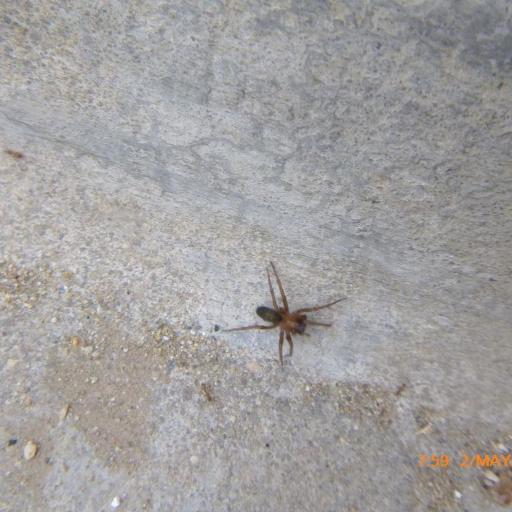
Often mistaken for a common house spider or a small wolf spider, Metaltella simoni—commonly known as the Hacklemesh Weaver—is a world traveler. Originally from South America, this unassuming arachnid has hitched rides across the globe, settling into gardens and crawlspaces across North America. While its appearance might startle you during a late-night trip to the kitchen, this spider is a quiet, hardworking roommate that pays its rent by eating the pests you actually don’t want around.
🔍 How to Identify
- 🦵 Mottled Coloring: They typically sport a brownish-orange or yellowish cephalothorax (the front part of the body) with a gray or mottled abdomen, often covered in fine, pale hairs.
- 🕸️ Messy Webs: Unlike the elegant circular webs of orb-weavers, this spider creates a "hacklemesh"—a tangled, fuzzy-looking web that lacks sticky glue but is incredibly effective at snagging insect legs like Velcro.
- 👀 Distinct Eyes: They possess eight eyes arranged in two rows, though they are quite small. You might notice their prominent spinnerets at the back of the abdomen, which they use to weave their signature woolly silk.
🌲 Habitat & Ecology
- 💧 Moisture Seekers: These spiders are big fans of humidity. You are most likely to find them under bark, beneath rotting logs, or indoors in damp areas like basements, bathrooms, and laundry rooms.
- 🦗 The Night Shift: As nocturnal hunters, they spend their days tucked away in silken retreats and emerge at night to wait for small insects, gnats, and even other spiders to stumble into their messy traps.
⚠️ Safety & Toxicity
- 🛡️ Low Risk: Metaltella simoni is not considered medically significant to humans. They are shy and would much rather run away than confront a "giant" like you.
- 🐜 Bite Potential: While they are capable of biting if squeezed or handled roughly, the reaction is usually less severe than a bee sting, resulting in minor redness or localized itching. They are not a threat to healthy pets or children.
✨ Fun Fact
The Hacklemesh Weaver is a "cribellate" spider. Instead of using sticky droplets of liquid glue to catch prey, they use a specialized plate called a cribellum to comb their silk into microscopic loops. This creates a "dry" adhesive that works by physically tangling the hairs and scales of an insect, much like the hook-and-loop fastener on a sneaker!
More Details








