Info
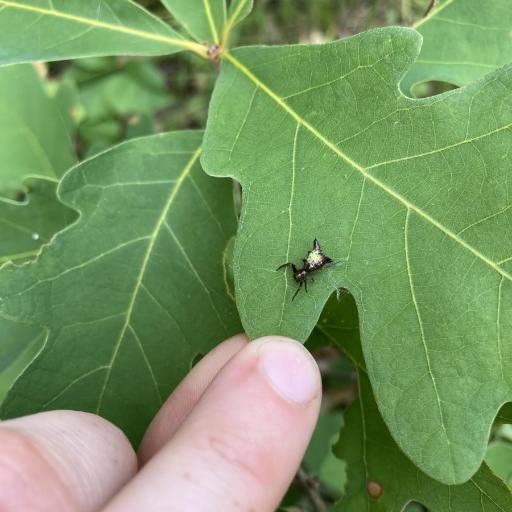
Often called the Arrowhead Spider, this tiny architect looks more like a piece of yellow jewelry or a medieval weapon than a common garden inhabitant. Found throughout North America, it is a master of visual defense, sporting a striking, triangular abdomen that serves as a "do not eat" sign for hungry birds.
🔍 How to Identify
- 🏹 The Arrowhead: Its abdomen is distinctively triangular, ending in two sharp, flared points at the rear that perfectly mimic the head of a primitive arrow.
- 🎨 Vibrant Contrast: The top of the body is usually a brilliant neon yellow or stark white, which contrasts sharply against its dark red or blackish legs.
- 📐 Spiny Texture: Beyond the main "horns," the abdomen features smaller black spines along the edges, giving it a jagged, armored appearance.
🌲 Habitat & Ecology
- 🕸️ Forest Understory: These spiders prefer the dappled sunlight of deciduous forests and overgrown garden edges, where they stretch their webs between shrubs or tall grasses.
- ☀️ The Center Stage: Unlike some spiders that hide in the leaves, the Micrathena sits proudly in the center of its vertical orb web during the day, waiting for gnats and small flies.
- 🛡️ Evolutionary Armor: Their rigid, spiky bodies are an evolutionary masterpiece; the sharp spines make them nearly impossible for small birds or lizards to swallow without injury.
⚠️ Safety & Toxicity
- ✅ Friend to Gardeners: This spider is a "friend." They are non-aggressive and provide excellent free pest control by catching flying insects that might otherwise bother your plants.
- 💧 Low Risk: While they do possess venom to subduing prey, it is not medically significant to humans. A bite is rare and usually feels like nothing more than a tiny pinprick or a mild sting.
- 🐾 Pet Safety: They are generally harmless to pets, though a curious dog that tries to eat one might be startled by the uncomfortable "crunch" of its spiny exterior.
✨ Fun Fact
When a Micrathena sagittata feels threatened, it doesn't just run; it can "bungee jump" off its web on a single silk safety line, disappearing into the leaf litter in the blink of an eye!
More Details








