Info
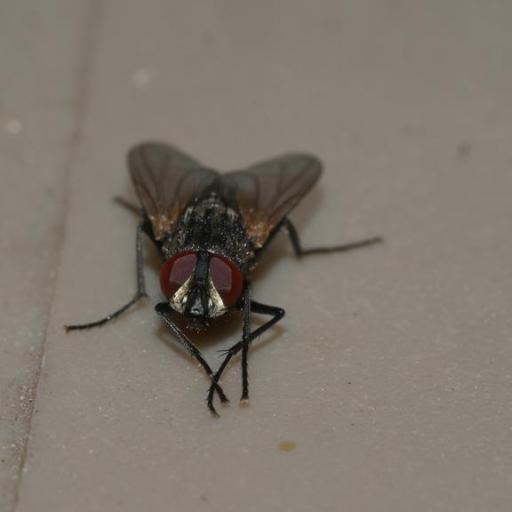
Known globally as the Housefly, Musca domestica is perhaps the most widespread animal on Earth. While often viewed as a simple nuisance, they are marvels of evolution, possessing reflexes that make them nearly impossible to swat. They have followed human civilization across every continent, thriving wherever there is warmth, food, and organic matter.
🔍 How to Identify
- 👀 Large Compound Eyes: Most recognizable for their massive, reddish-brown multifaceted eyes that provide a nearly 360-degree field of vision.
- 🏁 Thorax Stripes: If you look closely at their gray "shoulders," you will see four distinct, dark longitudinal stripes running down the back.
- 👅 Spongy Mouthparts: Unlike "stable flies," they cannot bite. Instead, they have a fleshy, trunk-like proboscis used to mop up liquid food.
🌲 Habitat & Ecology
- 🍴 The Liquid Diet: Because they lack teeth, houseflies must "pre-digest" solid food. They regurgitate specialized enzymes onto a surface to liquefy it before slurping it back up through their proboscis.
- ✈️ Aerobatic Mastery: They are some of the fastest-reacting creatures in the animal kingdom. They use tiny, knob-like structures called "halteres" behind their wings as biological gyroscopes, allowing them to perform complex aerial maneuvers in a fraction of a second.
- ♻️ The Great Recyclers: While bothersome indoors, in the wild, they play a vital role in breaking down decaying organic matter and returning nutrients to the soil.
⚠️ Safety & Toxicity
- 🛡️ Harmless Defense: Houseflies do not possess a stinger or the mouthparts required to bite humans or pets. They are physically harmless.
- 🦠 Pathogen Carriers: The primary safety concern is hygiene. Because they frequent waste and then land on human food, they can mechanically transport bacteria like Salmonella or E. coli on their sticky feet and body hairs. It is always best to keep food covered in their presence.
✨ Fun Fact
Houseflies actually "taste" with their feet! They have chemoreceptors on their lower legs that are millions of times more sensitive to sugar than the human tongue. This allows them to know if a surface is a viable meal the second they land on it.
More Details








