Info
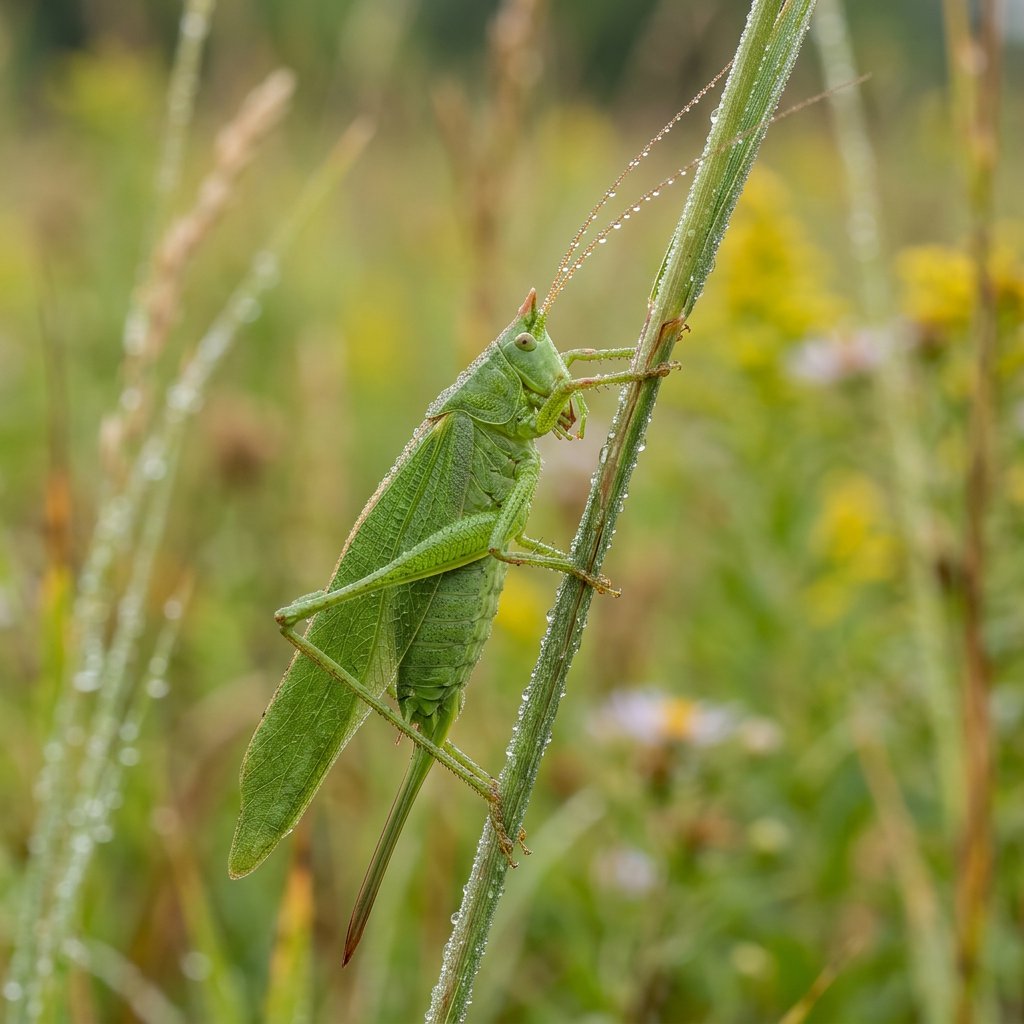
Often heard before it’s seen, the Sword-bearing Conehead is the "electric buzzer" of late-summer meadows. Despite the long, needle-like spike extending from the female’s rear, this insect is a peaceful grass-dweller rather than a tiny gladiator. It is famous for its sharply pointed head and a song so high-pitched that it can sometimes fade out of range for the human ear as we age.
🔍 How to Identify
- 📐 The Cone Head: They possess a distinct, sharply pointed forehead that resembles a dunce cap or a cone, which helps them blend perfectly into pointed grass blades.
- ⚔️ The "Sword": Females are equipped with an exceptionally long, straight ovipositor (egg-laying organ) that can be nearly as long as their body, resembling a rapier.
- 🍃 Color Phases: Most are a vibrant leaf-green, but a "brown morph" also exists, appearing the color of dried hay to stay camouflaged in parched autumn fields.
🌲 Habitat & Behavior
- 🌾 Grassy Hideouts: These insects are specialists of tall grasslands, weed lots, and cornfields. They spend their days clinging vertically to stems, perfectly mimicking a leaf or a seed head.
- 🎶 Mechanical Song: Males produce a continuous, rapid-fire buzzing sound by rubbing their wings together. It sounds like a high-speed mechanical drone or a vibrating power line that can last for several minutes without a break.
- 🍽️ Seed Crushers: Unlike some predatory katydids, the Sword-bearing Conehead is primarily a vegetarian, using its powerful mandibles to crush and eat the seeds of grasses.
⚠️ Safety & Toxicity
- 🛡️ Non-Venomous: Despite the "scary" spike on the female, they have no stinger and no venom. The spike is used exclusively for drilling into plants or soil to deposit eggs.
- 🦷 A Defensive Pinch: Because they have jaws designed to crack hard seeds, they can deliver a surprisingly strong pinch if you try to pick them up. It isn't dangerous, but it is enough to make you jump!
- 🐾 Pet Interaction: They are non-toxic to cats and dogs. However, their legs are quite spiny, which can cause minor mouth irritation if a pet tries to eat one.
✨ Fun Fact
A conehead’s ears are not on its head! Like most members of the katydid family, their hearing organs (tympana) are located on their front legs, situated just below the "knee" joint.
More Details








