Info
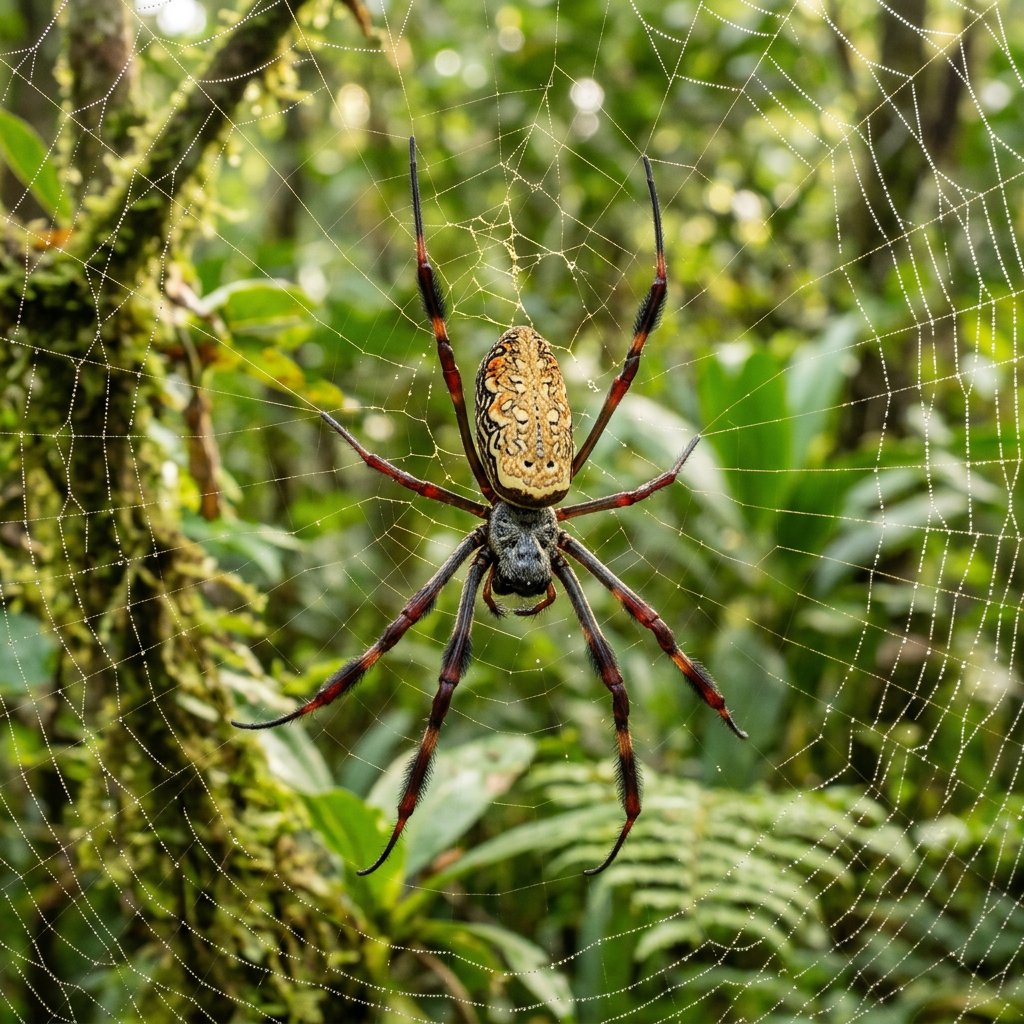
Known as the Hermit Spider or the Red-legged Golden Orb-weaver, this arachnid is a master of architectural disguise. Unlike many of its cousins who sit exposed in the center of their webs, this spider prefers the safety of a silk "condo" tucked away in a corner. Common in tropical gardens across Africa and South America, it is a fascinating neighbor that blends high-fashion colors with a shy personality.
🔍 How to Identify
- 🦵 "Bloody" Legs: The species name cruentata means "bloody," referring to the striking reddish-orange segments on its otherwise dark, spindly legs.
- 🎨 Shield Abdomen: It possesses a broad, flat-topped abdomen that is usually creamy yellow or beige, often marked with several dark, symmetrical pits or spots.
- 🏠 The Silk Retreat: The most obvious sign is the web; look for a funnel-like silk "tent" at the very top or side of the web where the spider hides during the day.
🌲 Behavior & Habitat
- 🦋 Pest Control Expert: These spiders are elite hunters of flying insects. They specialize in catching flies, moths, and even small wasps, making them a "friend" to gardeners who want to keep pest populations down.
- 🏡 Suburban Resident: While they love forests, they have adapted perfectly to human life. You’ll often find them on the eaves of houses, under porch lights (where insects gather), or between sturdy garden shrubs.
- 🕸️ Partial Orb-Weaver: Unlike a perfect circular web, their web is often an asymmetrical "half-moon" or semi-circle that radiates out from their silk hideout.
⚠️ Safety & Toxicity
- 🕷️ Passive Nature: The Hermit Spider is exceptionally shy. If you approach the web, it will immediately scurry deep into its retreat rather than try to bite.
- 🐝 Low Risk: Their venom is not medically significant to humans. On the rare occasion a bite occurs (usually from accidental handling), the pain is comparable to a mild bee sting with some localized redness.
- 🐶 Pet Safety: They pose no threat to cats or dogs. In fact, the spiders are more at risk from curious pets than the other way around.
✨ Fun Fact
The size difference between the sexes is extreme! A large female can be the size of a human palm, while the tiny male is often 5 to 10 times smaller—looking like nothing more than a tiny speck of dust hitching a ride on the female’s back.
More Details








