Info
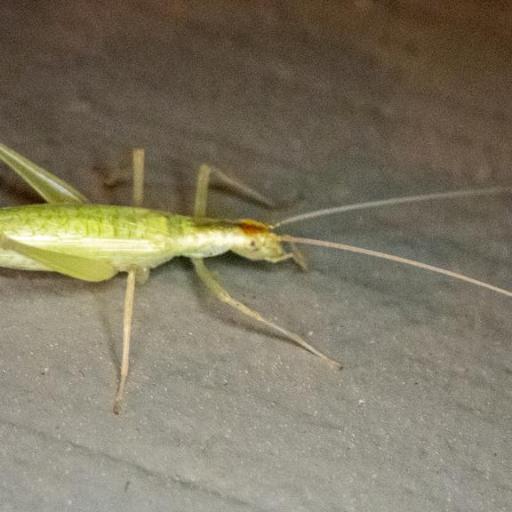
Known as the "Snowy Tree Cricket," this delicate creature is the ghostly soloist of the summer night. Often heard but rarely seen, its rhythmic, melodic chirping is a staple of evening garden soundtracks. These insects are famously nicknamed "Nature's Thermometer" because their biological functions—specifically the speed of their song—are tied directly to the surrounding air temperature.
🔍 How to Identify
- 👻 Ethereal Coloring: True to their name, they are a pale, translucent lime-green or creamy white, allowing them to blend perfectly with the undersides of leaves.
- 🏸 Paddle-Shaped Wings: Males have distinctively broad, flat, paddle-like forewings that they raise vertically to act as a megaphone when singing.
- 📏 Slender Profile: They have a very elongated, fragile body, usually reaching about an inch in length, topped with exceptionally long, thread-like antennae.
🌲 Habitat & Behavior
- 🍃 High-Altitude Living: Unlike common field crickets that hide under rocks, the Snowy Tree Cricket prefers the "penthouse," living in the canopy of deciduous trees, tall shrubs, and berry thickets.
- 🐜 Beneficial Predator: They are excellent garden roommates. While they occasionally nibble on soft foliage, their primary diet consists of aphids, scale insects, and other small pests that damage your plants.
- 🎶 The Synchronized Song: These crickets are unique because they often synchronize their chirps with neighboring males, creating a unified, pulsating rhythm that echoes through the neighborhood.
⚠️ Safety & Toxicity
- 🛡️ Completely Harmless: The Snowy Tree Cricket is a "look but don't touch" insect simply because it is so fragile. They possess no sting and are not known to bite humans.
- 🐶 Pet Friendly: They are non-toxic and pose no threat to curious cats or dogs. However, their delicate legs and wings break easily, so it is best to let them remain undisturbed in the foliage.
✨ Fun Fact
🌡️ Dolbear’s Law: You can use these insects to tell the temperature! To get a Fahrenheit reading, count the number of chirps in 15 seconds and add 40. This mathematical relationship between their metabolism and the weather is remarkably accurate.
More Details








