Info
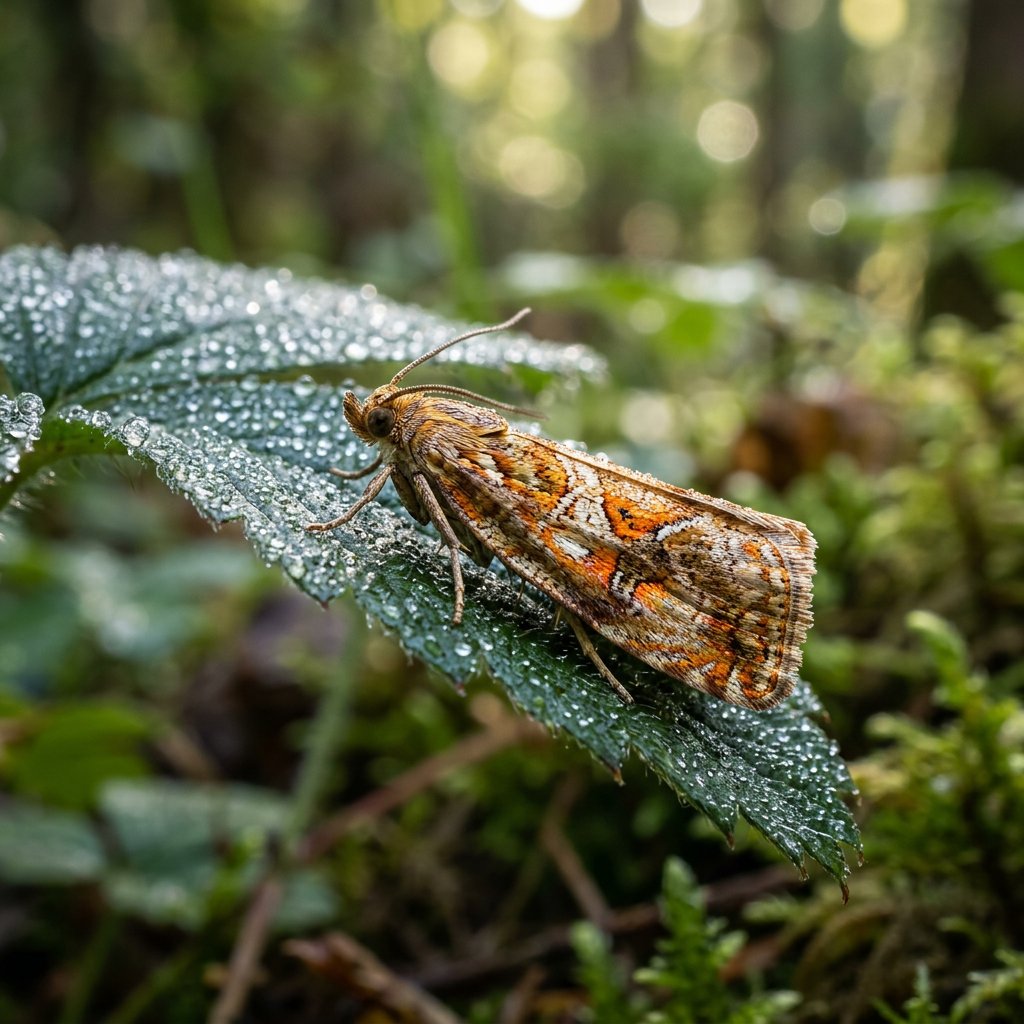
Known as the Arched Marble, this tiny moth is a true hidden gem of the insect world. Unlike many of its dull-colored cousins, Olethreutes arcuella looks like a miniature piece of stained glass or a complex mosaic. It is a diurnal moth, meaning it skips the moonlight to dance through woodland glades during the brightest parts of the day.
🔍 How to Identify
- 🎨 Intricate Patterns: The forewings are a stunning explosion of deep orange, adorned with metallic silver-blue streaks and bold black spots.
- 📐 Wing Shape: When at rest, it holds its wings in a roof-like position, showing off the characteristic "arched" markings that give it its name.
- 📏 Small Stature: It is quite dainty, with a wingspan usually measuring between 14 and 18 millimeters, making it easy to miss if you aren't looking closely.
🌲 Habitat & Ecology
- 🍂 Forest Recyclers: While many moth caterpillars are known for munching on prize garden flowers, the Arched Marble larvae prefer a "vintage" diet. They live among leaf litter, feeding on dead and decaying leaves.
- ☀️ Sun Lovers: You are most likely to spot the adults between May and August. They are particularly active in warm, sunny weather, fluttering around brambles and shaded woodland edges.
- 🗺️ Wide Range: They are common residents across Europe and temperate Asia, thriving in damp deciduous forests where leaf litter is plentiful.
⚠️ Safety & Toxicity
- ✅ Harmless Friend: The Arched Marble is completely safe. It does not bite, sting, or carry any toxins that are harmful to humans.
- 🐾 Pet Friendly: This moth poses no threat to curious cats or dogs. Its bright colors are more likely a form of camouflage against dappled sunlight rather than a warning of toxicity.
✨ Fun Fact
Despite its brilliant colors, the Arched Marble is a master of disguise. When it lands on a sun-dappled leaf, its complex pattern breaks up its silhouette, making it look like a harmless bit of bird dropping or a fallen flower bud to passing predators.
More Details








