Info
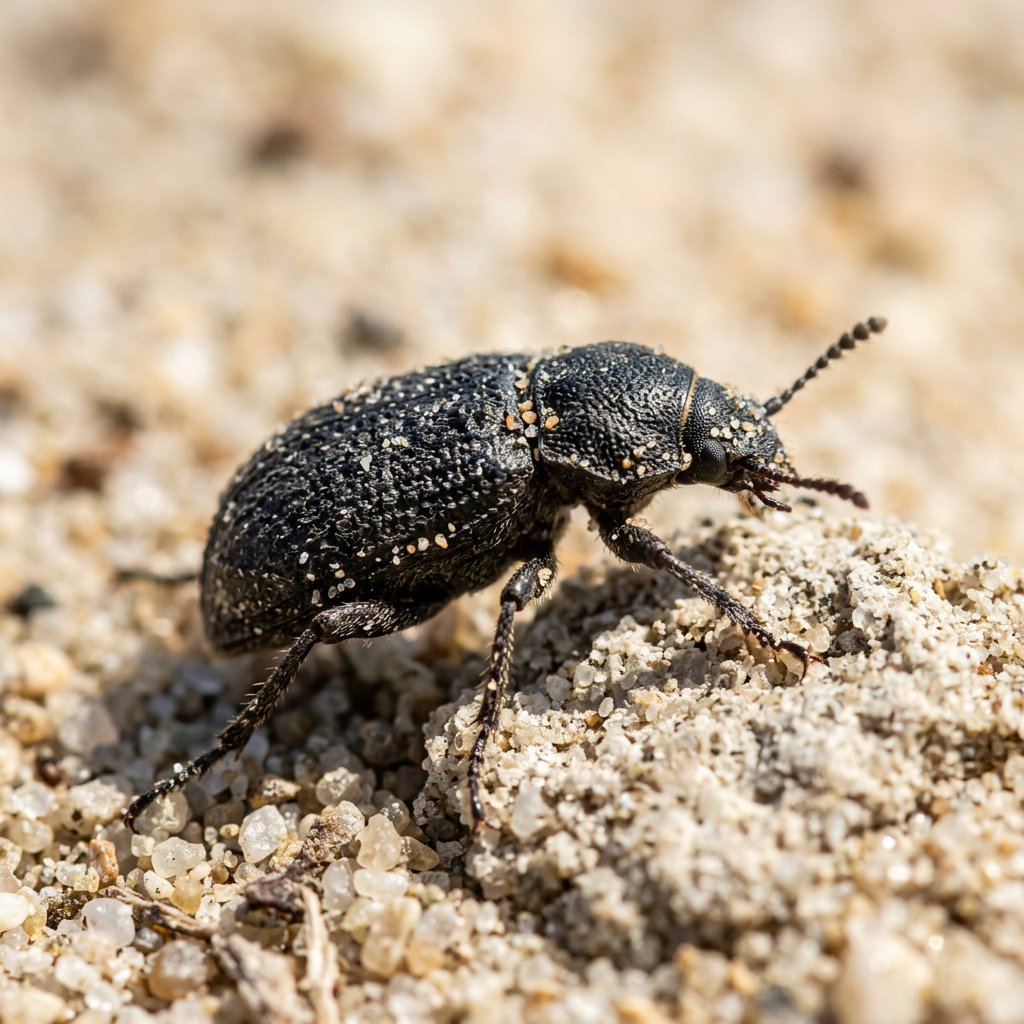
Often referred to as the Sand Weevil or Sand Darkling Beetle, this rugged little insect is a master of camouflage. Despite its name, it isn't a true weevil, but rather a member of the diverse Darkling Beetle family. You’ll usually find it blending perfectly with the dirt, looking more like a moving clump of soil than a living creature.
🔍 How to Identify
- 🛡️ The Dusty Coat: Its body is dull black or greyish, but it is almost always encrusted with sand or soil particles, making it look like a piece of weathered earth.
- 📐 Rugged Elytra: The wing covers (elytra) are not smooth; they feature distinct rows of small bumps and longitudinal ridges that help trap dust for camouflage.
- 🎭 Oval Shape: It has a broad, oval body with a head that is partially tucked into its "shoulders" (prothorax), giving it a stout, sturdy appearance.
🌲 Habitat & Ecology
- 🏜️ Soil Dweller: As its name suggests, it thrives in sandy or loose, dry soils. It is particularly common in vineyards, orchards, and fields where it can hide under clods of earth or leaf litter during the heat of the day.
- 🍴 A Generalist Eater: This beetle is a bit of a "foe" for farmers; both the adults and the larvae (which resemble wireworms) feed on the tender stems and leaves of young seedlings, including corn, sugar beets, and grapevines.
- 🌑 Low Profile: They are not strong fliers and prefer to crawl slowly across the ground. They are most active during the spring and early summer when the soil begins to warm.
⚠️ Safety & Toxicity
- ✅ Harmless to Humans: The Sand Weevil is completely non-toxic and lacks any form of stinger or venom. It does not bite humans or pets.
- 🌱 Garden Impact: While it poses no threat to your health, it can be a nuisance if you are trying to start a vegetable patch, as it may nibble on newly sprouted plants at the soil line.
✨ Fun Fact
The "dusty" look of the Sand Weevil is a deliberate survival strategy. Its exoskeleton is covered in tiny, stiff hairs that act like Velcro, specifically designed to catch and hold onto soil particles so it can vanish into the background of its habitat.
More Details








