Info
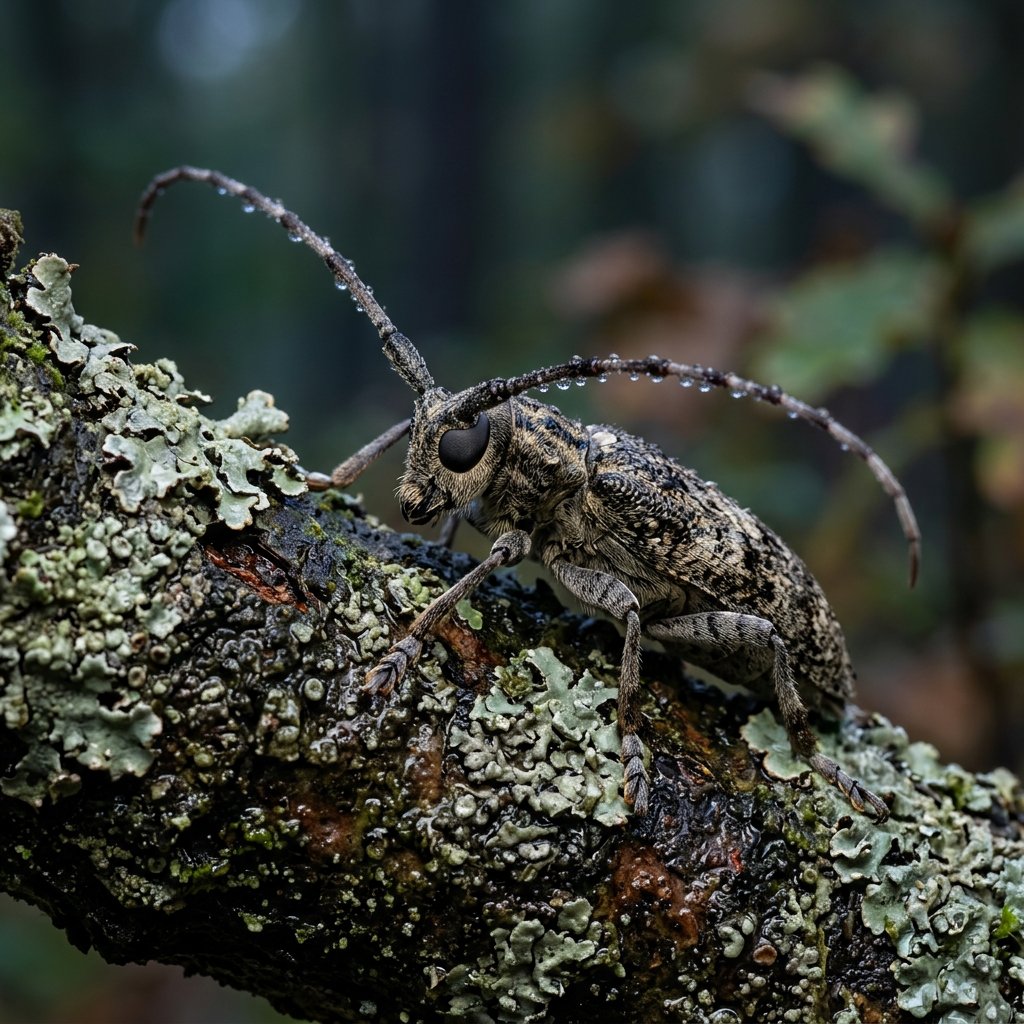
Known as the Linden Longhorn, this subtle beetle is a master of disguise against the bark of old trees. Often found in ancient woodlands, it acts as a tiny but essential forest recycler, breaking down fallen branches into nutrient-rich soil. While it belongs to the "longhorn" family—noted for their impressive antennae—this species is a gentle hermit of the woods that prefers to stay hidden.
🔍 How to Identify
- 🪲 Mottled Shell: The wing cases (elytra) are a soft grey-brown with irregular dark spots and patches, mimicking the appearance of weathered wood or lichen perfectly.
- 📡 Proportional Antennae: It features the signature long antennae of its family, though they are usually about the same length as its body, rather than the extreme lengths seen in other longhorns.
- 📏 Compact Build: It is a relatively small beetle, typically measuring between 9mm and 13mm, with a slightly fuzzy, matte texture that prevents it from reflecting sunlight.
🌲 Habitat & Ecology
- 🌳 Linden Specialist: This beetle is highly specialized; it almost exclusively seeks out the dead or decaying branches of Lime trees (Linden/Tilia), often those that have recently fallen or are still hanging.
- ♻️ Woodland Cleanup: As a "saproxylic" insect, its larvae live deep within dead wood. By boring into these branches, they help accelerate the decomposition process, making them a "friend" to the forest ecosystem.
- 🕰️ Ancient Resident: Because it requires specific conditions found in older trees, seeing one is often a sign of a healthy, long-established woodland area.
⚠️ Safety & Toxicity
- 🛡️ Harmless Neighbor: The Linden Longhorn is completely harmless to humans and pets. It possesses no stinger and is not aggressive.
- 🚫 Not a Household Pest: Unlike some of its relatives, this beetle has no interest in seasoned timber. It will not eat your furniture, floorboards, or garden fences, as it requires the specific moisture and fungal growth found in natural forest wood.
✨ Fun Fact
- 🎖️ A Rare Sight: In many parts of Europe, this beetle is considered quite rare and is used by conservationists as an "indicator species"—its presence tells scientists that a forest is ancient and biologically diverse!
More Details








