Info
Often called the Beech Leaf Miner, this tiny beetle is the hidden architect behind the brown, shriveled leaf tips often seen on beech trees in late spring. While they are small enough to sit on a pinhead, their incredible jumping ability has earned them a reputation as the "fleas" of the forest canopy. They are a classic sign of spring in European woodlands, emerging exactly as the beech buds begin to burst.
🔍 How to Identify
- 🪲 Tiny Silhouette: These beetles are exceptionally small, measuring only 2 to 3 millimeters in length, appearing as a dark, matte-black oval speck on the underside of a leaf.
- 👃 The Weevil Snout: Like all true weevils, they possess a "rostrum"—a tiny, downward-curved snout used for boring into plant tissue.
- 🦵 Spring-Loaded Legs: Their hind legs are noticeably thickened (saltatorial), much like those of a grasshopper, allowing them to snap into a high-speed jump if they feel a vibration.
🌲 Habitat & Ecology
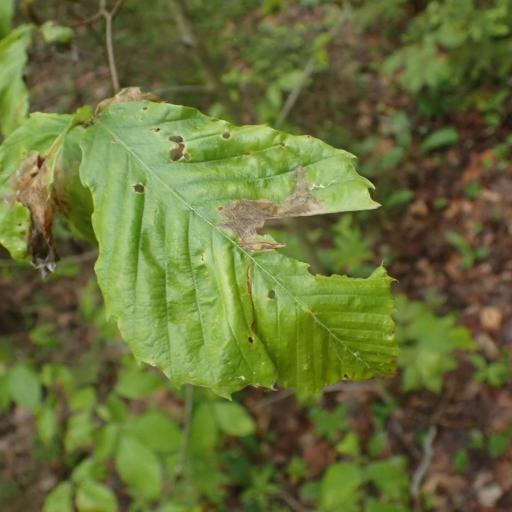
- 🍃 The Leaf Miner: The larvae live a "hidden" life. After the eggs are laid in the leaf midrib, the larvae hatch and eat the tissue between the upper and lower layers of the leaf, creating a characteristic brownish "blotch mine" at the leaf tip.
- 🍂 Winter Resilience: Adults are hardy survivors; they spend the winter hibernating in the deep crevices of tree bark or tucked away in the leaf litter on the forest floor, waiting for the first signs of warmth to climb back into the canopy.
⚠️ Safety & Toxicity
- ✅ Harmless to Humans: The Beech Weevil is entirely "friendly" to humans and pets. They do not bite, sting, or infest homes, as they are strictly tied to their host trees for survival.
- 🌳 Tree Impact: While a heavy infestation can make a beech tree look "scorched" or sickly by mid-summer, the damage is almost entirely cosmetic. Healthy trees easily survive the "shotholes" chewed by the adults and the mining of the larvae.
✨ Fun Fact
Despite being beetles, their jumping mechanism is so powerful that they can accelerate at speeds that make them nearly invisible to the naked eye during takeoff—a perfect disappearing act to escape hungry songbirds!
More Details








