Info
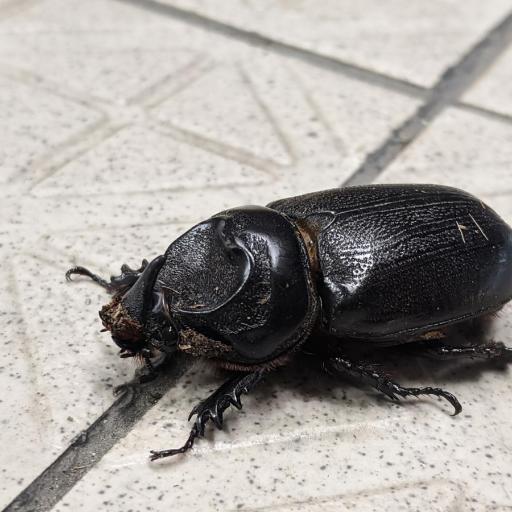
Often called the Asiatic Rhinoceros Beetle, this insect looks like a tiny, armored tank wandering through the tropical night. While its prehistoric horn might look like a weapon from a monster movie, this beetle is a gentle giant toward humans. However, it is a legendary "foe" to palm tree owners, known for its incredible strength and destructive appetite for tropical greenery.
🔍 How to Identify
- 🦏 The Horn: Its most striking feature is a single, backward-curving horn on the head. In males, this horn is long and prominent, while in females, it is much smaller or looks like a short stub.
- 🛡️ The Armor: The beetle is encased in a thick, glossy exoskeleton that ranges from deep mahogany brown to charcoal black, making it look like a polished gemstone.
- 🧶 Fuzzy Underside: If you flip one over (carefully!), you’ll notice a coat of fine, reddish-brown hairs on its belly, which help it sense vibrations in its environment.
🌲 Habitat & Ecology
- 🌴 The Palm Specialist: This beetle is a major pest in tropical regions. Adults use their powerful legs and horns to bore into the "heart" of coconut and oil palms to drink the sap, often leaving V-shaped cuts in the leaves as they unfurl.
- 🍂 Compost Nurseries: Unlike the adults who live in the treetops, the larvae (grubs) live on the ground. They are found in decaying logs, sawdust piles, or rich compost heaps where they turn rotting wood into soil.
- 🌙 Night Flyer: They are nocturnal and are frequently found near porch lights or street lamps, often crashing into walls with a loud "thud" because they are heavy, clumsy fliers.
⚠️ Safety & Toxicity
- 🛡️ Harmless to Humans: They do not sting and are not venomous. They are generally docile and will only try to push your hand away with their powerful legs if held.
- 🌵 Spiny Grip: Be cautious when picking them up; their legs are equipped with sharp spines for climbing trees, which can feel like a prickly scratch or a firm pinch on sensitive skin.
- 🐈 Pet Safety: These beetles are non-toxic. However, their extremely hard shells and spiny legs could cause a choking hazard or minor digestive irritation if a curious cat or dog decides to turn them into a snack.
✨ Fun Fact
The Rhinoceros Beetle is one of the strongest creatures on Earth relative to its size. It is capable of lifting 850 times its own body weight—the equivalent of a human lifting 65 family-sized cars at once!
More Details








