Info
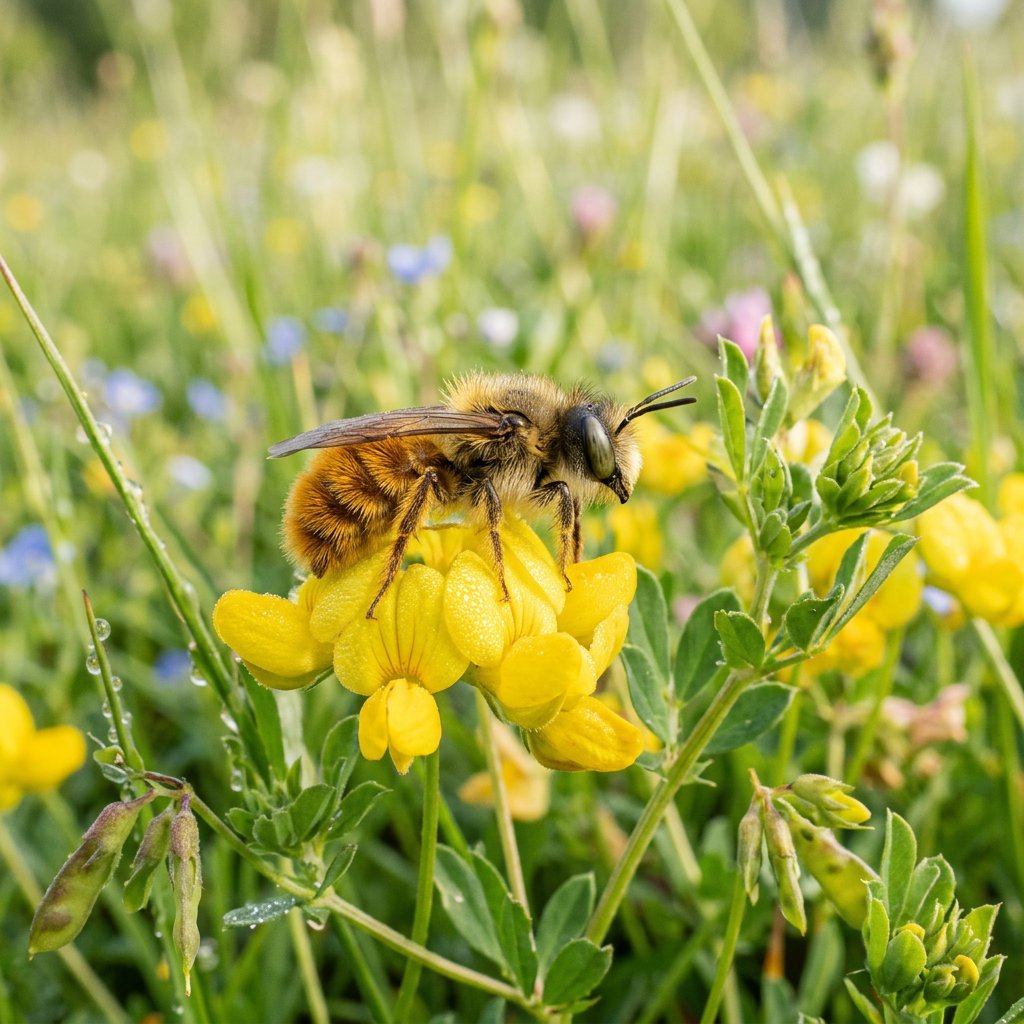
The Gold-fringed Mason Bee is nature’s tiny recycler with a very specific taste in real estate. Known for its shimmering coat of fox-red hair, this solitary bee ignores traditional hives or holes in wood, opting instead to turn empty snail shells into cozy nurseries. It is a vital, non-aggressive pollinator that brings a touch of "golden" magic to coastal and chalky landscapes.
🔍 How to Identify
- 🐝 Golden Shimmer: Covered in a dense coat of vibrant, fox-red or golden-orange hairs, particularly on the thorax and the top of the abdomen.
- 📏 Compact Build: They have a stocky, robust shape typical of Mason bees, measuring about 8–12mm—roughly the size of a small honeybee but much "fuzzier."
- 🧺 Abdominal Brush: Unlike honeybees that carry pollen on their legs, the female has a special brush of hairs (scopa) on the underside of her belly to transport pollen, often making her "tummy" look bright yellow.
🌲 Habitat & Ecology
- 🐚 The Snail-Shell Architect: This bee is a true specialist. It searches for empty land snail shells (like those of the Garden Snail) to use as a nest. It partitions the inside of the shell into several cells using a "pesto" made of chewed-up green leaves.
- 🌸 Coastal & Grassland Native: You are most likely to spot them in sunny, open spaces like sand dunes, limestone cliffs, or wildflower meadows where both snails and nectar-rich flowers (like Bird’s-foot Trefoil) are abundant.
- 🛠️ Shell Camouflage: Once the eggs are laid, the female often maneuvers the shell so the opening faces downward and may even cover it with bits of grass to hide it from parasitic wasps.
⚠️ Safety & Toxicity
- 🛡️ Peaceful Neighbor: The Gold-fringed Mason Bee is extremely docile. Because they do not have a queen or a hive to defend, they have no "aggressive" instinct.
- 🩹 Minimal Sting Risk: While females technically possess a stinger, they will only use it if they are physically crushed or trapped against the skin. The sting is much weaker than a honeybee's and is not considered a threat to humans or pets.
✨ Fun Fact
After sealing her nest, the female Gold-fringed Mason Bee can sometimes be seen "muscling" the snail shell into a new position, rolling it over the ground to find the perfect hiding spot among the vegetation!
More Details








