Info
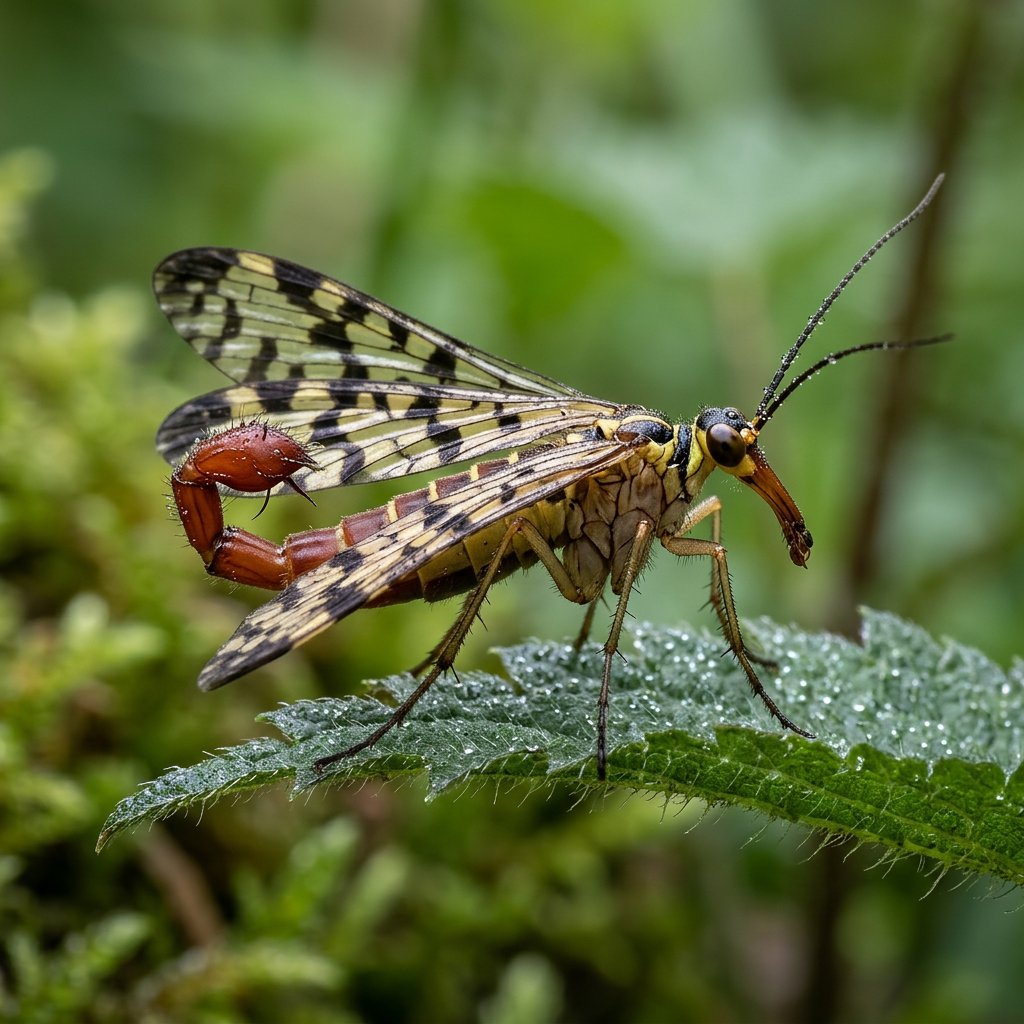
Often referred to as the "flying scorpion," the Common Scorpionfly is one of nature’s most fascinating optical illusions. Despite its intimidating tail that looks ready to strike, this ancient insect is a gentle scavenger that has lived on Earth since before the dinosaurs. Often found lurking in the shadows of hedgerows across Europe, it plays a vital role in the garden's cleanup crew.
🔍 How to Identify
- 🦂 The "Stinger" Tail: In males, the end of the abdomen is bulbous and curved upward, mimicking a scorpion’s stinger. In reality, this is a harmless genital organ used only during mating.
- 🎭 The Long Beak: Its head is elongated into a downward-pointing "rostrum" or snout, which it uses to feed on soft-bodied insects.
- 🏁 Mottled Wings: It possesses four clear, translucent wings heavily patterned with dark brown or black irregular spots, which it usually holds spread out in a "V" shape when resting.
🌲 Habitat & Ecology
- 🕸️ The Web Robber: These insects are notorious "kleptoparasites." They are often seen cautiously tip-toeing onto spider webs to steal trapped, dead insects, using their long legs to avoid getting stuck themselves.
- 🌿 Shady Sanctuaries: They prefer damp, shaded environments with dense vegetation. You are most likely to spot them resting on the broad leaves of stinging nettles or brambles during the late spring and summer.
⚠️ Safety & Toxicity
- ✅ Harmless: Despite its frightening appearance, the Common Scorpionfly is completely harmless to humans and pets.
- 🛡️ No Sting or Bite: It lacks a functional stinger and its mouthparts are designed for scavenging rather than biting skin. It is a "bluffer" of the insect world, using its looks to scare away potential predators.
✨ Fun Fact
To win over a female, the male Scorpionfly must present a "nuptial gift." He will often offer her a dead insect or a specially secreted drop of nutrient-rich saliva. If the gift isn't impressive enough, the female may fly away or even attack him!
More Details








