Info
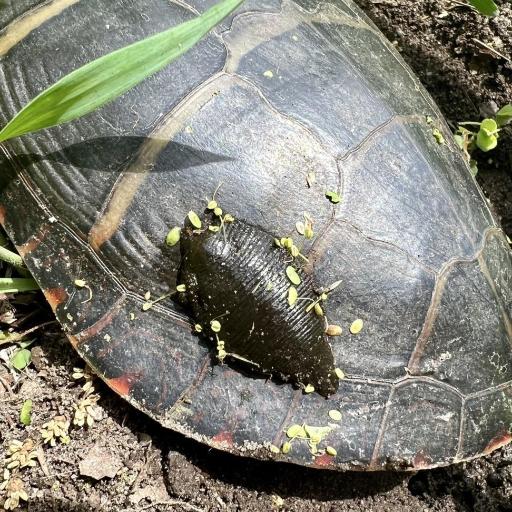
Often called the Turtle Leech, Placobdella parasitica is a fascinating aquatic hitchhiker that is more of a patient traveler than a mindless predator. While the word "leech" might cause a shiver, these colorful, leaf-shaped creatures are vital components of freshwater ecosystems and are famous for their surprising "parental" instincts—a rarity in the world of segmented worms.
🔍 How to Identify
- 🍃 Body Shape: It has a broad, flat, and oval-shaped body that looks remarkably like a wet leaf. It can stretch out to be quite long while swimming but bunched up into a thick teardrop when resting.
- 🎨 Intricate Patterns: Unlike plain black leeches, this species features a beautiful mosaic of olive green or brown, decorated with yellow-orange spots and a distinct longitudinal stripe down its back.
- 🔘 Dual Suckers: It possesses a small, inconspicuous sucker at the head and a much larger, powerful circular disc at the tail end, which it uses to anchor itself firmly to its host.
🌊 Habitat & Ecology
- 🐢 The Turtle Taxi: As the name suggests, its favorite "home" is the underside of a turtle’s shell or the soft skin around a turtle's legs. It uses these reptiles for both a steady food source and long-distance transportation through murky waters.
- 🏡 Freshwater Dweller: You are most likely to encounter them in stagnant or slow-moving ponds, marshes, and lake edges, particularly where there is plenty of submerged vegetation or woody debris to hide in.
- 🍼 Protective Parenting: In a touching display of nature, the parent leech carries its eggs—and later its hatched young—attached to its belly, protecting them from predators until they are large enough to fend for themselves.
⚠️ Safety & Toxicity
- 🩹 Status: Generally harmless but potentially startling. While they are blood-feeders, their primary "prey" are cold-blooded reptiles like Painted or Snapping turtles.
- 🤚 Human Interaction: If one attaches to a human wader, the "bite" is typically painless because they release a natural anesthetic. They do not carry diseases harmful to humans, but you should remove them gently (using a fingernail to break the suction) to avoid skin irritation or minor infection.
✨ Fun Fact
🐢 The Turtle Tracker: These leeches have evolved a specialized "chemical" sense that allows them to "smell" a turtle in the water from several feet away, letting them wait in ambush or swim toward their next ride!
More Details








