Info
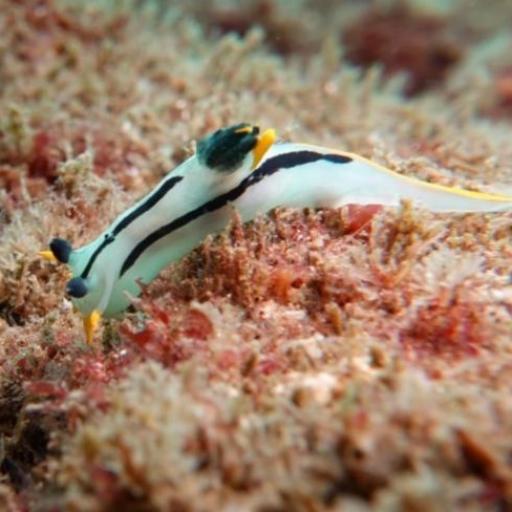
Known colloquially as the Cape Nudibranch, this striking marine traveler is often mistaken for an aquatic "bug" by beachcombers, but it is actually a shell-less sea snail. Found primarily along the rugged coastlines of South Africa, it looks like a tiny, bioluminescent dragon decorated with racing stripes. These "butterflies of the sea" are a favorite find for tide-pool explorers and scuba divers alike.
🔍 How to Identify
- ⚪ The Body: A translucent white or cream-colored body that usually grows to about 40-50mm in length.
- 🟡 Racing Stripes: Features bold, longitudinal yellow or orange lines running down the length of its back, often accented by small black or dark blue spots.
- 🪶 The "Crown": A conspicuous tuft of feathery gills located on the rear of its back, used for breathing underwater.
- 📡 Sensory Tentacles: A row of finger-like appendages (extra-branchial processes) surrounds the gills, and two prominent "horns" called rhinophores sit on the head to "smell" the water.
🌊 Habitat & Ecology
- 🇿🇦 Coastal Resident: This species is endemic to South Africa, meaning it is found nowhere else in the world. It thrives in rocky reefs and intertidal zones from the Atlantic side of the Cape Peninsula to Port Elizabeth.
- 🦠 Specialized Diet: Unlike insects that eat leaves, this nudibranch is a specialized predator. It feeds almost exclusively on Bugula, a type of colonial "moss animal" (bryozoan) that grows on rocks and kelp.
- 🐌 Slow & Steady: Because they lack a protective shell, they rely on their bright colors as "aposematism"—a warning to predators that they might taste terrible or be chemically defended.
⚠️ Safety & Toxicity
- 🟢 Status: Completely harmless to humans and curious explorers.
- 🚫 Hands Off: While they do not sting or bite, their bodies are incredibly delicate. Touching them can damage their sensory organs or disrupt the protective mucus layer that keeps them healthy.
- 🐱 Pet Safety: While unlikely to encounter a pet unless washed up on shore, they are not known to be dangerously toxic, though they are certainly not edible.
✨ Fun Fact
Despite their small size, Cape Nudibranchs are "hermaphrodites," meaning every individual possesses both male and female reproductive organs. When two meet, they both walk away capable of laying a spiral ribbon of eggs!
More Details








