Info
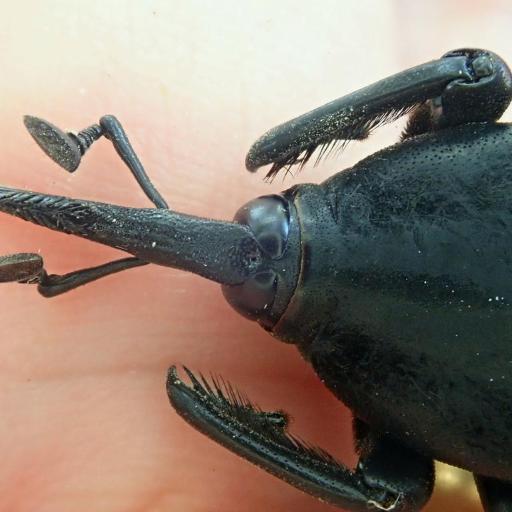
Known as the South American Palm Weevil, this insect is a heavyweight of the beetle world. Looking like a polished piece of obsidian with a long, elegant snout, it is often nicknamed the "Palm Killer" due to its devastating impact on tropical landscapes. While it may look intimidating with its armored body, it is a fascinating example of how a single insect can reshape an entire ecosystem.
🔍 How to Identify
- 👃 The Rostrum: The most striking feature is its long, curved snout (rostrum). In males, this "nose" is covered in tiny, brush-like hairs.
- 🖤 Vantablack Armor: The adult body is a deep, matte black or very dark mahogany, usually measuring between 1 and 2 inches in length.
- 🪱 The "Suri" Larva: The juvenile form is a giant, creamy-white, legless grub with a hard brown head. These larvae are often larger than the adults themselves!
🌲 Habitat & Ecology
- 🌴 Palm Specialist: This weevil is a specialist that targets various palm species, including Coconut, Date, and Canary Island palms. It is attracted to the scent of fermenting sap from wounded trees.
- 🦠 A Deadly Vector: The insect itself isn't the only problem; it is the primary carrier of the Red Ring Nematode, a microscopic worm that causes a fatal disease in palm trees, effectively "strangling" the plant from the inside.
- 🏗️ Master of Decay: By boring into the heart of the palm, the larvae turn the tree's core into a soft, fermented pulp, which eventually leads to the "toppling" of the palm crown.
⚠️ Safety & Toxicity
- ✅ Harmless to Humans: Despite its large size and formidable-looking snout, the South American Palm Weevil does not bite or sting. It is completely safe to handle, though its legs have a very strong grip.
- 🚫 Plant Emergency: For your garden, this insect is a "Red Alert." If you see holes in your palm trunks or notice the center leaves (the "spear") wilting and turning brown, the tree may already be infested.
- 🐕 Pet Safety: There is no known toxicity to cats or dogs, though the crunchy exoskeleton could be a choking hazard if a curious pet decides to investigate.
✨ Fun Fact
In many Amazonian cultures, the fatty larvae of this weevil (known as Suri) are a traditional delicacy! They are often harvested from fallen palms, skewered, and grilled over an open fire—tasting surprisingly like buttery bacon or roasted hazelnuts.
More Details








