Info
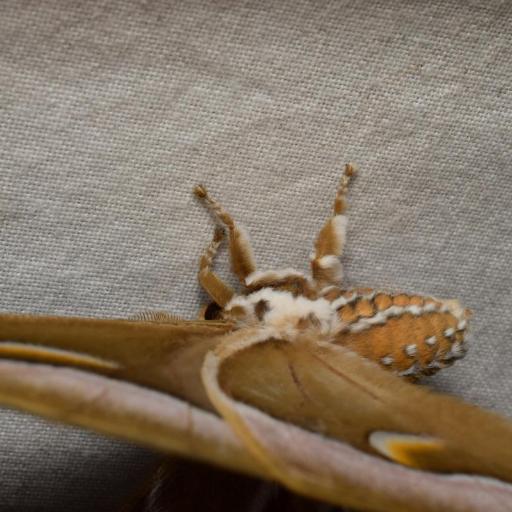
Known as the Ailanthus Silkmoth, this stunning giant was originally brought from East Asia to the United States and Europe in the 19th century with the hope of launching a new silk industry. While the commercial silk venture failed, the moth stayed behind, becoming a beloved sight for lucky night-watchers. These moths are famous for their "shaggy" appearance and their incredible ability to thrive in busy urban environments where other delicate insects might struggle.
🔍 How to Identify
- 🌙 Crescent Markings: Each of its four wings features a distinct, translucent white crescent or "half-moon" shape, often outlined in black.
- 🎨 Olive Palette: The wings are primarily a rich olive-green or brownish-tan, divided by a bold, pinkish-white band that runs horizontally across the body.
- ☁️ White Tufts: Its body is thick and "furry," covered in white wool-like tufts that make it look like it’s wearing a tiny, expensive fleece coat.
🌲 Habitat & Ecology
- 🌳 Tree of Heaven: This moth is inseparable from its favorite host plant, the Ailanthus altissima (Tree of Heaven). You will almost always find them where these trees are present, even in the middle of concrete-heavy cities.
- 🧶 Winter Cocoons: In autumn, the caterpillars spin tough, silk-wrapped cocoons that are cleverly attached to the leaf stalks of trees. To survive the winter, they wrap the silk around the twig so the "leaf" won't fall when the seasons change.
⚠️ Safety & Toxicity
- ✅ Harmless Giant: The Cynthia Moth is a "gentle giant." It does not bite, sting, or carry any toxins that are harmful to humans.
- 🐾 Pet Friendly: They are non-toxic to cats and dogs. In fact, adult moths don't even have functional mouthparts—they don't eat at all during their short adult life, focusing entirely on finding a mate.
✨ Fun Fact
The silk produced by this moth's genus is known as Eri Silk. It is highly prized in India because it is a "peace silk"—the moth is allowed to emerge and fly away before the cocoon is processed, unlike traditional silk where the larvae are destroyed.
More Details








