Info
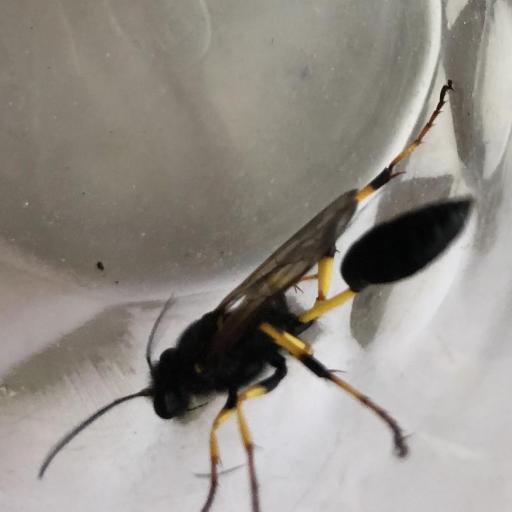
Meet the Sceliphron destillatorium, the slender engineer of the wasp world. Known for its impossibly thin waist and impressive masonry skills, this solitary wasp is more of a quiet neighbor than a backyard pest. While its long, dangling legs and twitchy wings might look intimidating mid-flight, it is far more interested in its career as a professional architect and spider-hunter than bothering your picnic.
🔍 How to Identify
- 🐝 The "Thread-Waist": Its most striking feature is the petiole—an incredibly long, yellow, needle-thin waist that connects the thorax to the abdomen, making the insect look like it's held together by a single wire.
- 🎨 Black and Gold: It sports a sleek jet-black body accented with bright yellow markings. Unlike many of its cousins, its legs are almost entirely yellow, which is a key identifying marker for this specific species.
- ✈️ Dangling Flight: When in the air, it flies with its long hind legs hanging downward, giving it a distinct, somewhat "clumsy" silhouette compared to the compact flight of a honeybee or yellowjacket.
🌲 Habitat & Ecology
- 🏗️ Master Masons: These are solitary "mud daubers." You won't find them in big colonies; instead, the female builds individual tube-shaped nests out of wet mud, often tucked into the cool shadows of window frames, attics, or porch eaves.
- 🕷️ The Spider Hunter: They are elite pest controllers. A female will hunt and paralyze spiders (often orb-weavers), stuff them into a mud cell, and lay a single egg. The paralyzed spiders stay "fresh" for weeks, serving as a living buffet for the wasp larva once it hatches.
⚠️ Safety & Toxicity
- 🛡️ Non-Aggressive: Because they don't have a "queen" or a social nest to defend, they are very docile. They will generally only sting if you physically squeeze them or step on them with bare feet.
- 🩺 Low Venom Potency: While a sting is painful (similar to a mild bee sting), it is not considered medically significant for most people. However, those with known insect allergies should always exercise caution.
✨ Fun Fact
The "waist" of this wasp is so incredibly thin that no major internal organs—like the stomach or heart—can actually fit through it; the petiole is essentially just a hollow structural tube containing nerves, muscles, and the "plumbing" for its circulatory system!
More Details








