Info
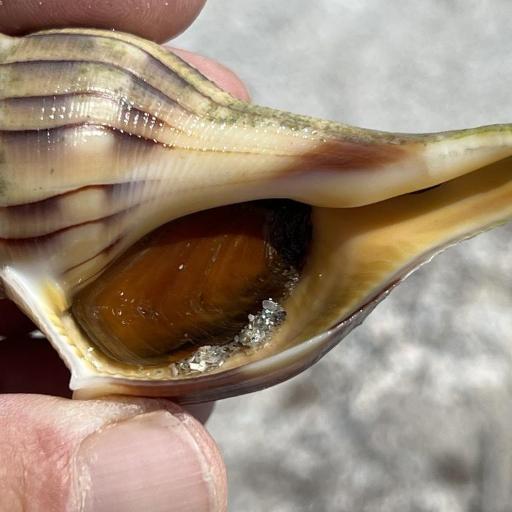
The Lightning Whelk (specifically the pulleyi subspecies) is a fascinating marine predator often found along the Gulf Coast. While you might find its beautiful shell washed up on the beach, it is actually a large sea snail rather than an insect. Known as the "left-handed" shell, it has been a prized treasure for beachcombers and indigenous cultures for centuries, often used as a ceremonial cup or a tool.
🔍 How to Identify
- 🐚 Left-Handed Spiral: This is its most famous trait. If you hold the shell with the point up, the opening (aperture) is on the left side, which is very rare in the snail world.
- ⚡ Lightning Streaks: The cream or grayish shell is decorated with long, wavy, reddish-brown or purple streaks that look like frozen lightning bolts.
- 🍐 Pear-Shaped Body: The shell features a wide, bulbous top that tapers down into a long, elegant "tail" known as the siphonal canal.
🌊 Habitat & Ecology
- 🏖️ Coastal Wanderer: These snails prefer shallow, sandy, or muddy bottoms in bays and estuaries. They are frequently spotted by beachcombers in the Gulf of Mexico after high tides or storms.
- 🦪 The Clam Cracker: They are slow but steady predators. A Lightning Whelk uses the edge of its own heavy shell like a pry bar to force open the shells of clams and oysters before eating them.
- 🥚 Snake-like Egg Cases: You may find their egg cases on the beach; they look like long, translucent, yellowish "snakes" made of small, interconnected parchment-like discs.
⚠️ Safety & Toxicity
- ✅ Harmless: The Lightning Whelk is completely non-toxic and safe for humans to handle. It does not have a stinger or a venomous bite.
- 🐚 Respect the Living: If you find a shell that feels heavy or has a leathery "trapdoor" (operculum) sealing the opening, the snail is still alive inside. Please return it to the water so it can continue its important role in the marine ecosystem.
✨ Fun Fact
The Lightning Whelk is the official State Shell of Texas! Because of its unique "left-handed" opening, many Native American tribes considered the shell a sacred object, often associating it with the spirit world and using it in important rituals.
More Details








